
 Governmetn websites:


 Election Commission
of
Pakistan
Election Commission
of
Pakistan 

Showing posts with label i love Pakistan. Show all posts
Showing posts with label i love Pakistan. Show all posts
3/8/11



1/13/10
Kaisa Ho Ga 2010?
Kya Hae Pakistan Ka Mustaqbil?
President of Pakistan: Abhi Pakistani aur khappay ga!
Yousaf Raza Gilani: What did president say???___ Jee bus wohi jee___ nahi jee___ bilkul wohi jee.
Governor Punjab: I hope there would be no graduation ceremony in 2010.
Shehbaz Sharif: There will be no building in Lahore that deserved to be demolished except Governor House.
Altaf Hussain: We will sit on stairs between government and opposition.
Nawaz Sharif: hahahahaha… what? 2010?… hahaha …what?
Imran Khan: Tehrik-i-Insaf will begin losing its baby teeth. InshaAllah!
Rehman Malik: There will be no Taliban element left in Pakistan except in Punjab , Sindh , N.W.F.P , Balochistan and Kashmir.
Ameer-e-Taliban: We will make some good decisions and will kill religious leaders instead of innocent people.
Chief Justice: Now I will enjoy a sound sleep till 2011.
Farzana Raja: In the whole year of 2010, at least one day poor women will get 2 waqt ki roti.
Fauzia Wahab: 2010??? …A nightmare for Media!
Chairman WAPDA: Hum se kuch achey ki umeed kion rakhtey ho bhai???

5/28/09
Happy Yaom-E-Taqbeer
It was the time to Answer 'Five' with 'Six'
And
it was 28th of May, 1998
When
PAKISTAN Said
Enough is Enough
And
Emerged as the
1st Muslim Nuclear State on the World Map.
Just Fell Big
And
Feel Pride on Being
PAKISTANI
Happy Yaom-E-Taqbeer
May PAKISTAN Live Long
Proud 2b a Pakistani
And
it was 28th of May, 1998
When
PAKISTAN Said
Enough is Enough
And
Emerged as the
1st Muslim Nuclear State on the World Map.
Just Fell Big
And
Feel Pride on Being
PAKISTANI
Happy Yaom-E-Taqbeer
May PAKISTAN Live Long
Proud 2b a Pakistani
-- 
5/25/09
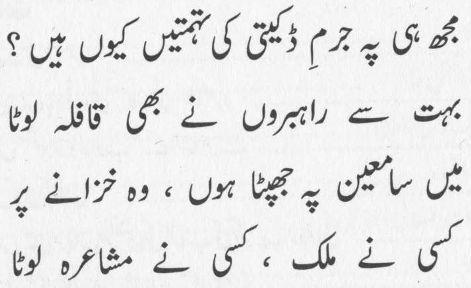
kisi ne mulk,tho kisi ne mushaaira loota
aa gayee! chaa gayee ! (came, saw and conquered). 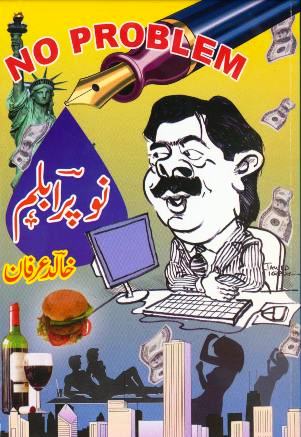 I recently came across poet Khalid Irfan’s latest book titled ‘No Problem’ and thought of Julius Ceaser’s veni, vidi, vici phrase. There are very few books that I have finished in one sitting and No Problem comes very close to it. I read it 75% in first sitting and then I had to go somewhere, otherwise it was too captivating to put down. Khalid Irfan is a Pakistani Origin poet living in New York. Many people say that he is considered as the successor of Dilawar Figar when it comes to humorous Urdu poetry. While that may be true, I think he has carried on his own individual style too.
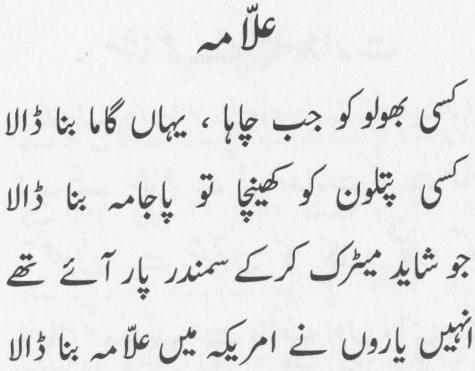
His poetry not only makes you smile but it also stings you, pokes you and makes you stop and think the deeper meanings. Khalid’s poetry is also very thoughtful and describes the plight of ‘desi’ families who come to the west and struggle to balance between their past values and the ones which belong to their new adopted home. Khalid, despite living outside Pakistan, keeps a keen eye on happenings there. Small but interesting news items like a ‘donkey wandering into a Islamabad building’ or a ‘robbery at a Karachi mushaaera‘ captures his imagination and he has said beautiful poems on them.
I read through the preface of the book and some where in there Khalid calls himself a serious poet and not a humorous one. In his own words he says that he never writes poetry to make people smile. He simply writes poetry the way it naturally comes to him. His style and choice of words do make people smile, and that too very contagiously.
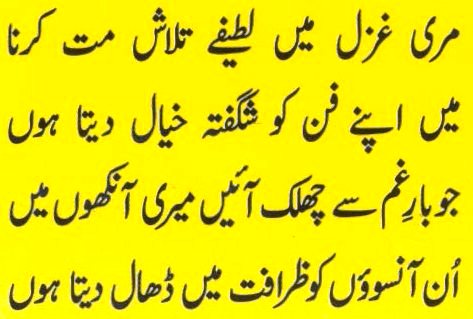
Following is another of my favorite works by him. Look at how beautfilly he has used the name of ‘Mianwali‘ city as a double edged sword here.
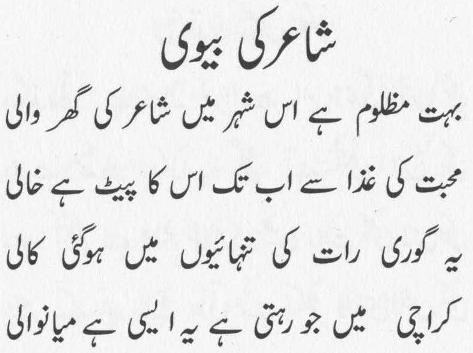
Since Eid-ul-Azha was just here, I wanted to share his following verses on ‘hilal-e-eid’.
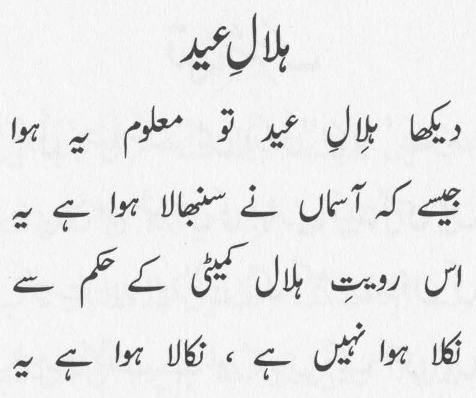
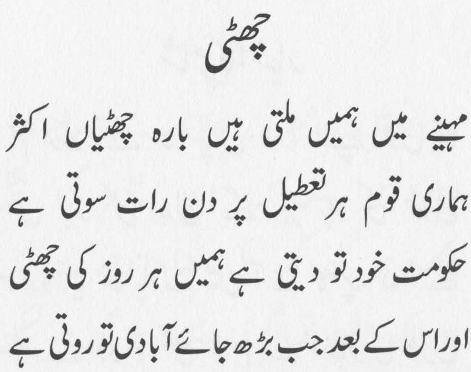
Following are two more of his works which I think will speak for themselves. I will let you enjoy them. First one is a satire on a large number of national holidays and second is a commentary on Y2K.

As I wrote above, his poetry not only makes you smile but it also stings you, pokes you and makes you stop and think the deeper meanings. When I was reading his book, I reached following ’sher’ and I was shocked for many seconds. I had to put down the book and think about this ’sher’. I think it is a bit provocative but those who have seen the violent scenes in Karachi’s turbulent 90s can easily relate to it. The sher goes like this:
hai kisi tifl-e-mohajir ki tarah sehma hoa
Khalid-e-Irfan ki shadi ka chohaara dekhna
After reading this ’sher’ I checked the date on it. Khalid wrote it first in 1994. One really needs to have lived through those years and those times in Southern Pakistan and this ’sher’ comes very close to home.
4/17/09
Inspiration Pakistan: Nehr Waaley Pul Tey
I must confess that the goriness of my last post still leaves me drained and shaken. I offer this picture post on the simpler pleasures of life in Pakistan, partly as a way of shaking myself off the shivers but much more as a way to highlight that not only is another Pakistan possible, another Pakistan actually exists.
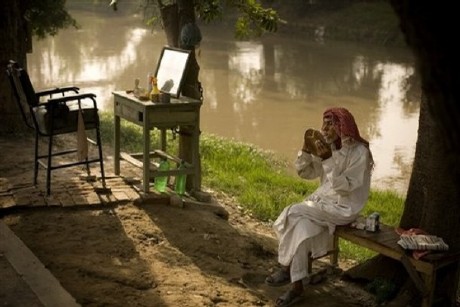
It is the Pakistan of this naai (desi barber) in this beautiful picture, from K.M. Chaudary of AP, who has set up his “open-air” barber shop by the canal in Lahore and, while waiting for customers to show up, decides to give himself a little grooming. The charming composition as well as the subject reminds me not only of my own memories (the best shave I ever had - after a period of growing an unruly beard - was from one such naee), but of the fact that very vast majority of Pakistanis are neither robbers who would hold children hostage nor a community of such unbridled anger that it would burn that robber alive. One must never forget this reality either. Largely because this reality gives hope and the possibility of better things. The reality of yesterday only breeds more anger and discontent.
This is not to say that we should ignore or underplay the reality of desperate people brutally burning robbers to death. We at ATP did not. It is to say, however, that the only thing worse than ignoring the ugliness amongst our own is to let it define the entirety of who we are; to let that ugliness make us forget all the beauty that also exists.
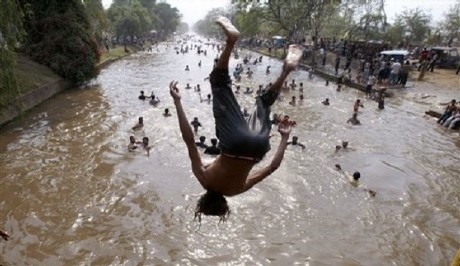
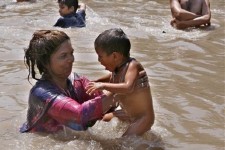
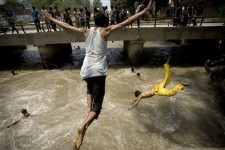
The beauty of the simple life lies in the daily struggles of the simple life. But also in the simple joys that give respite from those daily struggles. The life of the average Pakistani is never idyllic. It cannot be. But it is one that can be inspiring. There are few places better than the banks of the canal in Lahore where you can see on display those daily struggles and how people can find ways to enjoy life despite their struggles. Without having to shout at each other, abuse each other, kill or burn each other. This picture set below, also from K.M. Chaudary of AP, show just a few familiar scenes of how.
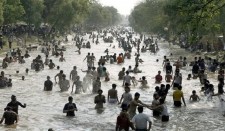
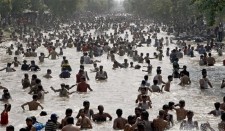
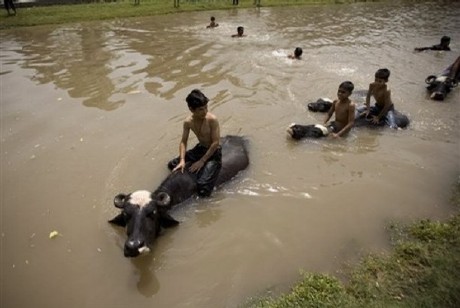
Post Script: Although I have mentioned that evergreen song from Noor Jahan, “Sannu Nehr Waley Pul Te Bulla Kay” in the headline, I will not post it now (even though I love the song) just because it does not quite match the mood of the post (or my own right now). For some reason the song that has been playing in my head today is not the one in the headline above but Baba G.A. Chishti’s epic super-hit “Tangay Walla Khair Mangda.”
As I had suggested in a post a year-and-half ago, that song - probably more than any other - describes (for me) what I and ATP do or are trying to do. Today I seem to be in a mood very similar to what I was feeling when I wrote that post, so I have been replaying that song again and again; in my head and on my computer.
Another face of Pakistan
After showing a face of Pakistan, we are back with another face of Pakistan. Photo Credits belong to Abdul Ali . The subject is employed at a road construction project in Quetta.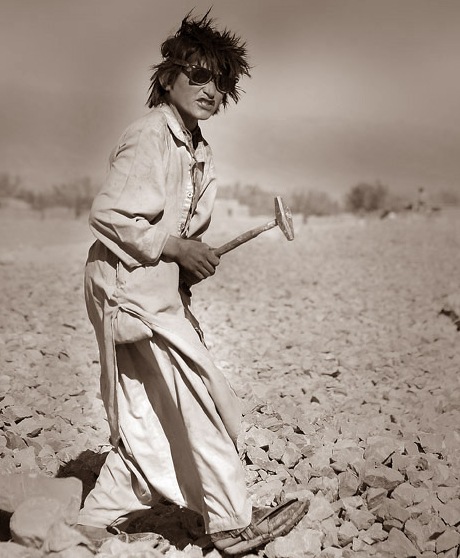
A face of Pakistan
Owais Mughal
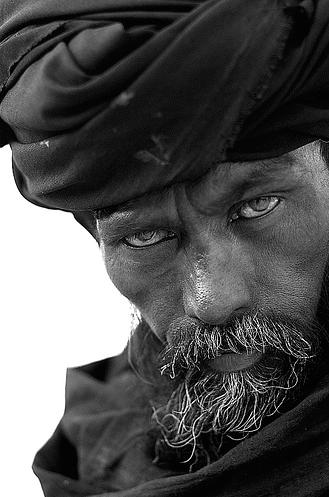 This photo is credited to famous photographer Fayyaz Ahmed.
According to Fayyaz’s notes, he found this subject at the tomb of Abdullah Shah Ghazi in Clifton, Karachi. When he asked for the photo permission, the subject replied:
“Whatever you wish”.
I saw this photo for the first time a few days ago but I keep coming back to it again and again. There is something about this guy’s eyes.
4/12/09
Print Ads From Pakistan of the 1950s
I own a copy of Pakistan Railway’s time table published in November of 1959. Besides train timings, it has a section of advertisements which is a great glimpse into our national past. I’ve selected following eight advertisements from this publication. Some of the brands advertised here are still in the market.
For good or bad a lot has obviously changed in the past 48 years. Not just in how the adverts were drawn and presented, but also in what was drawn and presented within them. It is a nice drive down memory lane.
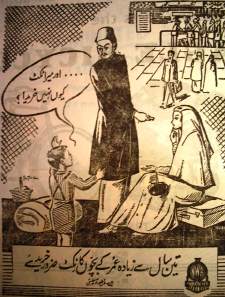


(1) Starting from the top, the first ad is a public notice advertisement asking public to buy railway tickets for children above three years of age. Note the male dress shown in this ad. It has definitely gone out of fashion. Imagine how difficult it must’ve been to do non-air-conditioned rail travel in a ‘sherwani‘. Note the dresses of parents are very Eastern style whereas the young boy is clad in all western. Also note the gesture of surprise shown by the lady. Such body language is also out of fashion now.
The last words in the advertisement show whom the ad is from. The words read NWR Publicity, which stands for North Western Railway (as Pakistan Railway was called until 1964) Publicity department.
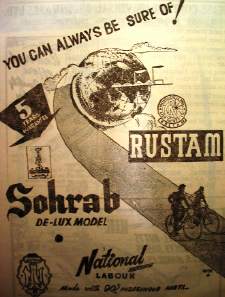
(2) The second advert is for Rustam and Sohrab bicycles. Most of you may be familiar that these bicycle brands are named after the epic Persian characters of Rustam and Sohrab from Shahnama-e-Firdausi. While both Rustam and Sohrab are not in this world anymore, Sohrab bicycle is still in production in Shahdara, Lahore. I am not very sure of Rustam brand though. May be our readers can enlighten us on Rustam brand’s current production level. I do remember seeing Rustam brand in my childhood.
An interesting thing to note in the advertisement above are the spellings of the word de-lux. Also note the words ‘National Labour’ showing the pride of manufacturers in utilizing local labor. The last line reads ‘made with 90% indiginous parts’. I wonder what were the 10% imported parts for a bicycle in 1959. May be the ball-bearings that connect to the pedal. Also note the offer of 5 Years Warranty for Sohrab and Rustam brands.
(3) Tibet Toilet Soap and Tibet Tooth Paste. Although not so popular now, Tibet brand products are still available. Note the word Dacca written as one of the cities where Tibet cosmetics were produced in pre-1971 Pakistan. I wonder what do the words ‘Twice as Lovely’ mean? How can we quantify loveliness. Probably it means that after using Tibet products, one will become twice as lovely as compared to their current degree of loveliness. By extrapolating this statement, a mathematical mind may also deduce that Tibet beauty products can thus make an ugly person turn into half ugly (= twice lovely). Ok I’ve gone too far. Lets go back to the 50s!
(4) This is an advertisement for Bombay Cloth House in Anarkali bazar, Lahore. Note the 4 digit telephone number for Lahore City in this ad. I guess these days extensions in a single building run in 4 digits
(5) In the set below the ad on the left says ‘Don’t rob the nation!’ This advertisement is self explanatory. I just want to mention one thing here. What is the symbolism of hand approaching the train? Does it symbolize the ‘long arm of the law’. It seems to be going to the wrong place though i.e. the locomotive. An engine driver is exempt from buying a rail ticket, remember!


(6) Trains don’t wait. This interesting ad is from West End Watch company located at M.A. Jinnah Road, Karachi. Can somebody confirm if they are still in business? The ad gives the message that West End watches offer a guaranteed timely arrival for you to catch a train. What is interesting is the man in the advertisement seems to be wearing a West End Watch (note the red wrist strap) and the train is seen departed.
(7) In this advertisement for Roznama ‘Tameer,’ Rawalpindi, note the dress this guy is wearing while reading the Daily ‘Tameer‘ (To Build). Also note the items in circles which show the highlights of what the daily ‘Tameer’ stands for. Despite all the noble mottos, I believe this newspaper is not in circulation anymore.


(8) The final ad here is for Sartaj Sewing Machine and Sartaj Bicycle. Sartaj industries had a very diversified product line in 1959: sewing machines and bicycles. In this ad they are offering their sewing machine for monthly installments of Rupees 10 only. Also note how 4-digit telephone numbers are used as decoration all over the ad.
(Clicking on the photos in this article will take you to their large size and easy to read images)
Education Pakistan: The Class of 1947
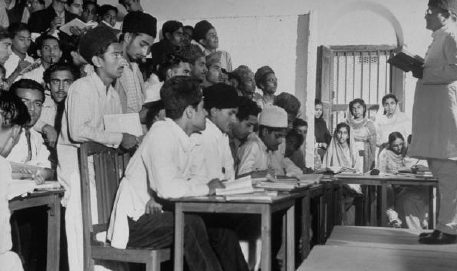
it is Government College Lahore. The photograph was taken in December 1947 by LIFE magazine famous photographer Margaret Bourke-White, and is of freshmen students in a physics class. What made the picture interesting to me was that it was taken in 1947.
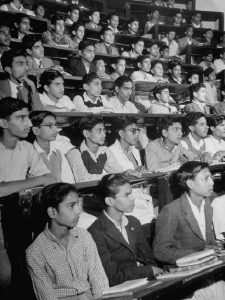
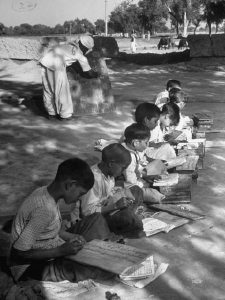
There is a whole series of photographs by Margaret Bourke-White of education in Pakistan, as witnessed by her camera lens in December 1947. The one of the left (above) is of the same class at Government College Lahore. The one on the right is of first graders in a school at Faizpur, near Lahore. They represent two faces of Pakistan’s “Class of 1947.”
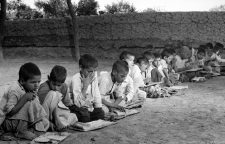
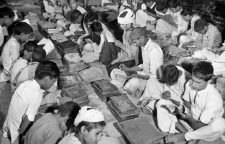

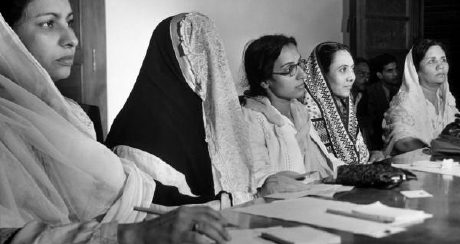
In introducing the Quiz, I had hoped that we might get more detail on some of the people in the photograph or commentary on the fact that this was taken in 1947 itself. I hope we might get some of that discussion now. To aid this process, we present more photograph’s from Margaret Bourke-White’s collection on education in Pakistan.
All these photographs were taken in 1947. The ones in the block above include (L to R):
- Sind Moslem College, Karachi. Freshman English class. Note that this is co-educational, with girls sitting behind a partition (purdah) separating them from the boys.
- Village Elementary School, Fairpur, near Lahore. FIrst grade students studying under the open sky.
- Village Middle School, Burj Attari, near Lahore. Fifth and Sixth grade students studying in a joint class. Note the metal boxes in front of them.
- Home School, Burj Attari, near Lahore. Teachers tending First through Fourth grade girl students in a home school.
- Pakistani Women’s Education Conference, Karachi. A November 1947 educational conference on women’s education. Khadeeja Feroze Ud-din (2L), Deputy Directress of Public Instruction of West Punjab, in purdah.
In looking at all these different faces of Pakistan’s “Class of 1947″, what can we say about the Class of 1947? What was expected of it? What was delivered? What has changed? What has not? What was achieved? What lost?
4/1/09
Pakistan in Washington’s Smithsonian Museum
Outside Pakistan any reference to mother land naturally catches our attention . Last week I got chance to visit Washington DC’s Smithsonian National Museum of Natural History (NMNH). This museum was opened in 1910 and was among the first building built for Smithsonian to house national treasures. Among other treasures of knowledge and research preserved in the museum, there is a section dedicated to Pakistan. The whole theme of Pakistani pavilion is around a ‘bazaar’ being the center of social activities in a Pakistani village.

Shown above is a scene of Pakistani village depicted at Smithsonian Museum of Natual History in Washington D.C.
While the information given about Pakistan in the museum is correct and displayed articulately, my only comment is that it does not cover the whole story. It gives an impression as if Pakistan is all tribal or nomadic and it completely ignores the well-settled, pretty modern and educated urban centers. The display also seems to date back from 1960s or 1970s as evident from the truck photos below.
Pakistani Trucks Also Made it to the Smithsonian Museum:
As mentioned in one of our earlier posts, the indigenousTruck Art of Pakistan is also featured in the museum. I apologize for the average quality of photos but the originals were quite faded too. The truck photos seem to be from 1970s therefore they are not as colorful as present day truck photos. The trucks also show an interesting image of a boeing with PIA (Pakistan International Airlines) written on the tail. This got to be pre-1980 image because in 80s all trucks changed their aviation related art from commercial planes to F-16s and then in 90s to Titanic.


Scenes From a Pakistani bazaar:
As written above, a traditional village bazaar of Pakistan is featured and modeled in the museum. Following write-up on a plaque is how it is described in exact words. On another plaque it was written that people from all ‘quarters’ of a city meet at bazaar and mosque. The plaque reads:
People from all ‘quarters’ of a city meet at bazaar and mosque. Though they may live in separate, often walled and hostile, parts of the city, the various groups are economically independent. To satisfy the need for a safe meeting area, both customs and religious law guarantee the neutrality of the market. In addition to conducting business in the bazaar, people visit with friends or relatives, hear news or proclamations from the market crier, and conduct legal affairs with scribe, official witnesses and judges. Tea shops in the bazaar have long been the common meeting ground for men.
 I doubt if the above plaque’s writing is completely true anymore. There is no village crier for sure. There are no more walled cities with hostile population. Only Lahore, Multan and Hyderabad have people living in walled cities now which also constitute less than 1% of the city population. That is why I think some of the information needs to be updated at the museum. Photo to the right above shows Smithsonian NMNH’s entrance.
Yet another plaque describes a Pakistani village bazaar as the center of economic activity in following words.
In the market the necessities of life, as well as the most expensive luxury goods are available. Though much of the material sold in bazaar is also made there, the owners of individual stalls ofter have special ties, based on kinship, to producers in oultying independent villages. These loyalties have often been in conflict with the aims of the central government, which throughout history has treated the bazaar as an important source of revenue through taxation.

Following photos show a bazaar scene as displayed in the museum. The photo to the left show various household items seen in a village bazaar for sale. The photo to the right is the wooden seat used on a camel.


A Balochi Village:
There is this life size black and white photo in the museum which shows a temporary village of nomads in Balochistan.

Reference:
1. Smithsonian National Museum of Natural History
Subscribe to:
Posts (Atom)


 English Newspapers


 Dars-e-Quraan
 Dr. Israr Ahmad