
 Governmetn websites:


 Election Commission
of
Pakistan
Election Commission
of
Pakistan 

Showing posts with label Pak Info. Show all posts
Showing posts with label Pak Info. Show all posts
6/11/11

3/21/11
EarthQuake in Islamabad Pakistan
Just suffered from a huge earth of 5.1 magnitude in islamabad pakistan. isb 20 march 2011

3/12/11
3/11/11
3/8/11



3/1/11

6/14/10


9/5/09
ISI Summons RAW Chief Over Terrorism In Pakistan
ISI Summons RAW Chief Over Terrorism In Pakistan
Pakistan slaps India with evidence of RAW’s involvement in Terrorism inside Pakistan
Ø In the Sri Lankan cricket team case, Indian operatives crossed the border from Indian to join other Indian-origin or Indian-trained terrorists who traveled all the way from Afghanistan to Lahore
Ø Indian terrorism training bases, intelligence outposts and personnel in Afghanistan identified
Ø In some cases, Indian intelligence was indirectly supporting attacks against US soldiers in Afghanistan in order to worsen Pak-US military relations
Ø India’s friends, advocates and lobbyists in Washington stunned
Indian Prime Minister Manmohan Singh was stunned when Pakistani Prime Minister Yousaf Reza Gilani handed him a dossier containing photographs of Brahamdagh Bugti and other terrorists meeting Indian agents not only in Afghanistan but also during their visits to India and the names of the Indian officials who met them. This was part of more evidence about India’s involvement in recruiting, training, financing and arming terrorists in Afghanistan and sending them to Pakistan. India’s links to the attack on the Sri Lanka cricket team in Lahore and other high profile terrorism cases have been established, shocking even Indian’s many advocates in Washington. Mr. Gilani gave this surprise to the Indians behind closed doors. Now India fears that Pakistan would use this meeting to expose Indian connections with two anti-Pakistan terrorist leaders and their foreign-funded terror armies: Brahamdagh Bugti and his BLA [Balochistan Liberation Army] and Baitullah Mehsud’s Tehreek-e-Taliban Pakistan, both being supported from bases in US-controlled Afghanistan.
By Dan Qayyum
ISLAMABAD, Pakistan—ISI Chief Shuja Pasha has summoned his Indian Counterpart, K C Verma for a meeting through the Indian defense attaché in the Indian High Commission in Islamabad.
The Indian government has not responded to ISI’s request yet, and is reportedly assessing the implications of a possible meeting carefully.
After the July 16 Sharm el-Sheikh joint statement between India and Pakistan, India fears that Pakistan would use this meeting as a forum to expose Indian connections with two terror leaders and their foreign-funded terror armies: Brahamdagh Bugti and his BLA [Balochistan Liberation Army] and Baitullah Mehsud’s Tehreek-e-Taliban Pakistan.
Pakistan has piles of evidence against Indian consulates in Afghanistan being used to fund terrorism in Pakistan through the TTP as well as the terrorists who claim to be self-styled representatives of Pakistan’s Baloch vast Baloch heritage.

Pakistan’s DAWN reports that a dossier containing proof of India’s involvement in “subversive activities†in Pakistan was handed over by Prime Minister Yousuf Raza Gilani to his Indian counterpart Manmohan Singh during their meeting at Sharm el-Sheikh last week.
The evidence has also been shared with the US and Afghanistan, with Kabul being asked to prevent the use of its territory for disruptive activities against Pakistan.
“Although the information given to India is being kept highly secret, broad outlines of the dossier available with Dawn reveal details of Indian contacts with those involved in attacks on the Sri Lankan cricket team and the Manawan police station,†the newspaper said.
“Operatives of RAW who remained in touch with the perpetrators of the attacks have been identified and proof of their interaction has been attached,†it added.
A description of Indian arms and explosives used in the attack on the Sri Lankan team has been made part of the dossier, besides which the names and particulars of the perpetrators, who illegally entered Pakistan from India and joined their accomplices who had reached Lahore from Waziristan, have been mentioned, the report said.
The dossier is also said to list the safe houses being run by RAW in Afghanistan where terrorists are trained and launched for missions in Pakistan.
“The dossier also broadly covers the Indian connection in terror financing in Pakistan.
A substantial part of the shared material deals with the Balochistan insurgency and Indian linkages with the insurgents, particularly Brahamdagh Bugti, Burhan and Sher Khan,†Dawn said.
Photographs of their meetings with Indian operatives are part of the evidence, which also describes Bugti’s visit to India and the meetings he had with Indian secret service personnel, it added.
The dossier also mentions an Indian-funded training camp near Kandahar where terrorists claiming to represent Pakistan’s Balochistan, particularly supporters of politician-turned-terrorist Akbar Bugti, were being trained and provided arms for sabotage activities in the Pakistani province. The elder Bugti was involved in recruiting and sending young Pakistanis from Balochistan to become terrorists against their own homeland.
Dawn quoted its sources as saying that Manmohan Singh had agreed to “look into Pakistani claims†and to take “corrective action†if proven. He is said to have assured Mr. Gilani that India is against interference in other countries and Pakistan’s stability was important for them.
“Yes, these issues were discussed,†Foreign Office spokesperson Abdul Basit said when asked about the meeting.

Indian Backed Terrorism in Pakistan
Brahamdagh is based in Kabul and is a familiar face within the defense and intelligence circles in Delhi.
BLA was the name that the former KGB and the Indian intelligence gave to Pakistani communist recruits who were paid to destabilize Pakistan during the 1960s, ‘70s and ‘80s, when the Soviet Union controlled Afghanistan. The BLA died with the end of the Cold War and the Soviet withdrawal from Afghanistan, but has been revived by the Indians after US occupied Afghanistan.
Here is what Christine Fair of RAND Corporation has said earlier this year about what the Indian consulates are up to in Afghanistan and Iran:
“I think it would be a mistake to completely disregard Pakistan’s regional perceptions due to doubts about Indian competence in executing covert operations. That misses the point entirely. And I think it is unfair to dismiss the notion that Pakistan’s apprehensions about Afghanistan stem in part from its security competition with India. Having visited the Indian mission in Zahedan, Iran, I can assure you they are not issuing visas as the main activity! Moreover, India has run operations from its mission in Mazar (through which it supported the Northern Alliance) and is likely doing so from the other consulates it has reopened in Jalalabad and Qandahar along the border. Indian officials have told me privately that they are pumping money into Baluchistan. Kabul has encouraged India to engage in provocative activities such as using the Border Roads Organization to build sensitive parts of the Ring Road and use the Indo-Tibetan police force for security. It is also building schools on a sensitive part of the border in Kunar–across from Bajaur. Kabul’s motivations for encouraging these activities are as obvious as India’s interest in engaging in them. Even if by some act of miraculous diplomacy the territorial issues were to be resolved, Pakistan would remain an insecure state. Given the realities of the subcontinent (e.g., India’s rise and its more effective foreign relations with all of Pakistan’s near and far neighbors), these fears are bound to grow, not lessen. This suggests that without some means of compelling Pakistan to abandon its reliance upon militancy, it will become ever more interested in using it — and the militants will likely continue to proliferate beyond Pakistan’s control.â€
The Foreign Policy magazine also recently confirmed the Indians were neck deep in supporting the TTP in Pakistan:
While the U.S. media has frequently reported on Pakistani ties to jihadi elements launching attacks in Afghanistan, it has less often mentioned that India supports insurgent forces attacking Pakistan. “The Indians are up to their necks in supporting the Taliban against the Pakistani government in Afghanistan and Pakistan,†a former intelligence official who served in both countries said. “The same anti-Pakistani forces in Afghanistan also shooting at American soldiers are getting support from India. India should close its diplomatic establishments in Afghanistan and get the Christ out of there.â€
Afghan officials have also confirmed that India is using Afghanistan to stir trouble in Pakistan.
“India is using Afghan soil to destabilize Pakistan and Afghan security agencies are unable to stop Indian intervention due to absence of centralized government mechanismâ€, said Afghan Government’s Advisor, Ehsanullah Aryanzai on the sidelines of Pak-Afgan Parliamentary Jirga at a Pakistani hotel on April 2, 2009.

Pressure on the US
The Americans – under heavy pressure in Afghanistan – have started to realize they cannot save face in Afghanistan unless Pakistan’s legitimate concerns with regards to Indian sponsored terrorism are addressed immediately.
A Senior US diplomat William Burns gave Indian officials a terse directive last month, asking them to ’shut down Indian consulates in Afghanistan, reduce presence in Kabul and stop sending terrorists across the Durand Line.’ The message was supplemented with a letter from the American President Barack Obama to Indian Prime Minister Manmohan Singh with a similar message.
Whether RAW’s K. C. Verma takes up ISI chief Shuja Pasha’s offer of a one-on-one or not, Pakistan should increase the pressure on the US by declaring neutrality in Afghanistan and block the supply of American and NATO weapons through its soil unless the United States pays heed to its Pakistani ally’s security interests in the region.
The original version of this report is published by PKKH. 9/4/09
Indian Army Major-General Runs Terrorist Camps Inside Afghanistan
Indian Army Major-General Runs Terrorist Camps Inside Afghanistan
o India Begins To Scale Down The Activities Of Its ‘Diplomatic’ Outposts; Pakistan Is Yet To Verify This; Terrorism Against Pakistan Will Continue Until Kabul & New Delhi Surrender Brahamdagh Bugti & Other Terrorists
o 8 Spy Foreign Agencies Active In Balochistan; No One Paying Attention To The 9th one: Oman
Eight foreign intelligence agencies are meddling in Pakistani Balochistan. There is a 9th possible player: Oman, where US and UK and reportedly Israel maintain ‘listening and monitoring outposts’. But it is the wily Indians who walk away with the top prize. For seven years now, India has played the lead role in spreading terror inside Pakistani Balochistan. India’s reckless adventurism has emboldened other players. But it is also emboldening Pakistan to respond. India cannot get away with this and stealing Pakistan’s water in Kashmir.

BY AHMED QURAISHI
KABUL, Afghanistan—As the United States military occupation of Afghanistan falters, regional powers move in for the kill. Afghanistan has many neighbors. India is not one of them. It does not share any borders with Afghanistan. But after CIA, India’s two intelligence services – the Research & Analysis Wing (RAW) and Defense Intelligence Agency (DIA) – are among the most active in the occupied country.
The Indians have excellent contacts within Karzai’s security setup. Most of them are former communist leaders who escaped to India in the 1970s and ‘80s and returned to power along with the Northern Alliance in 2001, backed by both US and India.
The Indians have also sold the Americans, or at least some key people within the American intelligence and strategic communities, on the dubious Indian ‘expertise’ on Afghanistan. This is how India was assigned an expanded role inside Afghanistan. The role takes the form of development work on the surface. But in reality, the Indians are neck deep in Afghanistan, and now it turns out they are neck deep inside western Pakistan as well.
The Indians have a separate, extensive intelligence and espionage setup focused on Pakistan’s tribal Pashtun belt. This is where the Indians and Karzai’s people are running a joint venture of pumping saboteurs into Pakistan disguised as the so-called ‘Pakistani Taliban’, who are also known as the Fake Taliban to differentiate them from the Afghan Taliban who are fighting the foreign armies in Afghanistan and are not fighting Pakistan.
This report focuses on India’s espionage work in southern Afghanistan targeting Pakistan’s Balochistan province.
Apart from the Indian Embassy in Kabul, there are nine consulates strategically located in the US-occupied country.
India has two consulates in the south near Pakistan’s three key areas: the provinces of Balochistan and NWFP and the tribal belt. One Indian consulate is located in Kandahar. The other one is located close to the airport in Lashkar Gah, capital of the Helmand province. This Indian ‘consulate’ has a training facility where training is imparted to would-be terrorists. Here they are equipped and sent to Pakistan. Most of these terrorists are young men recruited from both Pakistan and Afghanistan. Indian ‘diplomats’ from the two southern consulates have been sighted collecting large quantities of Pakistani rupees from the open market on several occasions.
Interestingly, Helmand is the same province where the United States and the United Kingdom have mobilized their military and intelligence resources to fight al Qaeda and the Taliban and push them toward Pakistan.
From Pakistan’s point of view, this US-NATO operation is bogus. After all, the Afghan Taliban are registering success in Afghan provinces that are nowhere near the Pakistani border, including northern Afghanistan. There is no evidence that the Afghan Taliban managed to do this because of help from Pakistani soil. And yet US-NATO forces forget Taliban everywhere else and decide to focus on Helmand which borders Pakistani Balochistan, a province that is being destabilized from the Afghan soil.
Knowing that this operation could be used by intelligence operatives [Indian, Afghan and possibly even American] to push undercover agents and saboteurs inside Pakistan, Pakistani authorities formally objected to Washington over the military action noting very clearly that pushing terrorists inside Pakistan is not a solution.
On top of the nine Indian consulates, six more ‘diplomatic’ outposts have been established by both RAW and a Karzai spy outfit called NDS.
The six new ‘consulates’ are part of a network headed by a retired major-general from the Indian army. His CV shows that he used to head RAW’s counterintelligence wing based in New Delhi.
His job description is simple.
In intelligence parlance, he is responsible for identifying strategic opportunities in Afghanistan and Pakistan and use them to India’s advantage. He is expected to cultivate, recruit, train, arm and finance espionage and sabotage inside Pakistan in a calculated manner resulting in supporting India’s wider political and strategic objectives in the region.
In simple everyday language, the Indian officer is supposed to open enough fronts for Pakistan from the west in order to distract Pakistan’s grip and attention over Kashmir, the Indian occupied region to the east.
The Indian major-general has led an operation where young men from Pakistan and Afghanistan have been recruited in the name of waging jihad against America. Once in, the young men are brainwashed. They are shown violent speeches by supposed religious clerics. They are introduced to ‘mujahedeen leaders’ who enjoy vast knowledge in Islamic and Quranic teachings. Most of these ‘mujahedeen leaders’ are either Indian or Karzai’s intelligence people.
The brainwashing sessions include virulent sermons against Pakistan and its role in betraying Islam. The indoctrination ends with the mission that Pakistan needs to be the first target in the jihad against America. Whoever sides with Pakistan in this battle is a supporter of America’s occupation of Iraq and Afghanistan.
These young men with ‘messed up minds’ are then sent to Pakistan to carry out bombings, suicide attacks, targeted killings, and slaughter innocent people.
Most of them are introduced as Islamic militants or Taliban. But a large number of them are also sent in to pretend they are Pakistanis fighting for the separation of Balochistan from the motherland.
As soon as these terrorists finish blowing up pipelines or killing university professors in Balochistan’s provincial capital Quetta, Indian consulates in Afghanistan arrange for their Urdu writers to pen down neatly written statements in Urdu which are then dispatched to Pakistani news organizations. Some analysts who have had a chance to look at these statements are impressed by the high quality of the Urdu language used in these written press statements. [Non-Pakistani readers may not understand the significance of this point. A small minority in northeast India, a region that has been the seat of Muslim nobility and empire for most of the past ten centuries, continue to be well acquainted with Urdu, the language of the old Muslim nobility in the region. The terrorists spreading havoc in Pakistani Balochistan do not enjoy even a moderately acceptable command over this classical language. The only other people outside Pakistan who can show off a few experts in this language are Indians from the northwestern part of their country.]
Exploiting a barren, rough terrain, the Indians and Karzai’s security people have identified routes along three regions in southwest Pakistan – Dalbandin, Noshki and Chaman – as transportation routes for weapons and bombs smuggled into the province.
Pakistani security forces have consistently been confiscating US and Israeli manufactured weapons from terrorists in various parts of southwest Pakistan bordering Afghanistan.
Intelligence agencies from eight different countries are suspected to be active in the wave of terror inside Pakistan. These spy outfits belong to the United States, India, Afghanistan, Iran, UAE, Israel, Britain and Russia.
Pakistani authorities have been slow in discovering the role of a 9th country in this mix: Oman.
Oman is situated right across the Arabian Sea, facing the coastal line of Balochistan. Thanks to cross migrations between Oman and Pakistan over the past two centuries, a substantial portion of the Omani population is of Pakistani Baloch descent. They have traditionally worked for the security service and the army of successive Omani kings, including the incumbent, Sultan Qaboos bin Saeed.
At least two countries, the US and Britain, have intelligence ‘listening and monitoring outposts’ in Oman. There have been reports that Sultan Qaboos bin Saeed had also granted Israel the right to use his territory for discreet information gathering operations targeting neighboring countries, especially Iran and the region surrounding the Strait of Hormuz. This area includes Pakistani Balochistan.
Apart from the Indians, Washington is known to be very interested in Balochistan. The Pakistani province offers the shortest land route to Afghanistan should Islamabad decide to cease support to NATO and US supply lines through the rest of Pakistan. The Americans are also suspicious that a hard-to-defeat Afghan Taliban are based in Balochistan.
The suspicion is that at some level Oman is helping US access Pakistani Balochistan without the knowledge of the Pakistani government.
The nine foreign intelligence agencies are in Afghanistan for various purposes. The American and the Omani roles have been explained. Karzai’s intelligence is simply ready to join any effort that harms Pakistan. The Indians want to punish Pakistan for supporting the struggle of the Kashmiri people against Indian occupation. India also wants to destabilize Balochistan enough so that China abandons the huge development projects inside the Pakistani province, an objective that the Americans would welcome without hesitation.
Iran is more concerned about the CIA-backed Jundullah terrorist group that is working on setting the Sunni Balochi population inside Iran against the Shiite majority. The Dubai emirate of the UAE has been told by the Indians that Pakistan’s Gwadar port in Balochistan is being developed as competition. There is also suspicion that some lobbies within the UAE are aligned with the American agenda on Iran, especially considering that Iran occupies three UAE islands. Pakistani Balochistan figures prominently in this agenda. I am referring to ‘lobbies inside the UAE’ because while Dubai is suspicious about Gwadar it is not interested in joining any anti-Iran effort. But Abu Dhabi, the other influential emirate in the UAE, is more susceptible to go along the Americans on Iran, including the idea of using Balochistan for this purpose.
The Brits are also closely aligned with the Americans. The case of the Israelis, however, is more interesting. Israel is the only country with the longest experience in dealing with Islamic groups. Israel has gone as far as establishing Islamic religious schools inside Israel that serve intelligence purposes, such as understanding how fighters are indoctrinated and also how to develop undercover agents who can go and join Islamic groups disguised as Muslim extremists.
Washington sought Israeli assistance in this regard after 9/11. The Indians were smarter. They approached Israel in the 1990s to counter Islamic groups backed by Pakistan. These groups were at the forefront of the Kashmiri people’s fight against the Indian occupation of Kashmir. Israeli has demonstrated it can help India in Kashmir in May-June 1999 when a defeated Indian army unit there was provided Israeli military assistance on the ground to repel advancing Pakistani and Kashmiri fighters. [The timely and effective Israeli assistance helped turn a tactical Pakistani military victory into defeat, providing India enough time to mobilize a diplomatic offensive to invite international intervention in Kashmir. This is according to a rare disclosure by Mark Sofer, Israel’s ambassador to India, in a Feb. 2008 interview with an Indian news magazine.]
There is a strong probability that Israel’s help is once again at play in India’s anti-Pakistan activities on the Afghan soil. The Israelis are also focused on Iran. This leaves out the Russians who are most probably fishing in troubled waters and are there to reclaim the influence they lost in the area with the end of the Soviet Union 18 years ago.
But it is the Indians who walk away with the prize. They have played their cards well and convinced likeminded lobbies in Washington to let them use the Afghan soil against Pakistan for a good seven years now. But as the situation deteriorates for the Americans inside Afghanistan, a desperate Obama administration is listening to Pakistani complaints for the first time and possibly taking some action to reign in their wayward Indian friends.India's Nuclear Test Was A Dud?
India's Nuclear Test Was A Dud?

One reason for the timing of the latest embarrassing disclosure by an Indian scientist is to ward off growing American pressure on India to sign various nuclear containment treaties and perhaps enable India to conduct one last series of tests to validate and improve its nuclear arsenal.
By S. M. Hali
ISLAMABAD, Pakistan—The admission by a senior Indian nuclear scientist that the Indian nuclear tests at Pokharan-II in May 1998 were a dud, have shaken India.
This revelation has confirmed the suspicion voiced by international as well Pakistani scientists immediately after the tests that the seismic measurements indicated that the only thermonuclear device tested was a “fizzle”.
In nuclear parlance, a test is described as a fizzle when it fails to meet the desired yield.
K. Santhanam, senior scientist and DRDO representative at Pokharan II, director for 1998 test site preparations, told Times of India that the yield for the thermonuclear test, or hydrogen bomb in popular usage, was much lower than what was claimed.
The test was said to have yielded 45 kilotons (KT) but was challenged by western experts who said it was not more than 20 KT. The exact yield of the thermonuclear explosion is important as during the heated debate on the India-US nuclear deal, it was strenuously argued by the government’s top scientists that no more tests were required for the weapons program and computer simulations would be enough in future design.
The question here arises regarding the timing of the disclosure of the failure of thermonuclear tests. Why would Santhanam go public, with such deliberation, on something that was commonly discussed and widely acknowledged in scientific circles?
The answer, according to some nuclear experts, is to ward off growing American pressure on India to sign various nuclear containment treaties and perhaps enable India to conduct one last series of tests to validate and improve its nuclear arsenal.
US nuclear experts, taking cognizance of Santhanam’s admission have also concluded that Indian scientists are yearning to conduct more nuclear tests to validate and improve the country’s arsenal before the Obama administration shuts the door on nuclear explosions.
Henry Sokolski, Executive Director of the Washington DC-based Nonproliferation Policy Education Center, confirmed the same and opined that Washington has long believed that geo-political objectives rather than scientific or technical metrics drives New Delhi’s nuclear weapons quest.
In scores of research papers and studies in the immediate weeks and months of the 1998 nuclear tests in Pokharan, US and British scientists repeatedly questioned the reported yield of the Indian thermo-nuclear device, saying it was well below India’s claim of 43-45 kilotons.
In fact, some scientists, notably Terry Wallace, then with the University of Arizona and now attached to the Los Alamos National Laboratory, put the combined yield of the three May 11 tests at as low as 10 to 15 kilotons. Two other tests on May 13 involved sub-kiloton devices for tactical weapons, which US scientists doubted even, took place.
India thus appears to be divided in two groups, those who want to test and those who do not.
P.K. Iyengar former head of Bhabha Atomic Research Center and former chairman of Atomic Energy Commission of India, told BBC that he had made it clear in 2002 that India’s nuclear tests were ‘inconclusive and ambiguous’.
Indian Prime Minister Dr. Manmohan Singh and former National Security Advisor, Brajesh Mishra, quoting former Indian President and scientific adviser to the Defence Minister Dr. A.P.J. Abdul Kalam for claiming success of the Pokharan-II tests, have discredited Santhanam’s exposé. Vicky Nanjappa’s interview of K. Santhanam for Rediff.com in ‘Why K Santhanam said Pokharan II was not a success’ quotes Santhanam, when asked to comment on Dr. Kalam’s rebuttal, as saying: “I would like to react to that. First of all, Dr Kalam is not a nuclear scientist. He is a missile scientist and he was not present there at that time. He is blissfully ignorant of the facts. Do I need to say more?”
Even Santhanam, regarding the belated timing of his disclosure admits that “There is a change in the administration in the United States of America. They are bound to further pressurize India to sign the CTBT. In such an event it was necessary to make such a statement or speak the truth on the issue so that India does not rush into signing the CTBT.”
Gary Milholin Director of the Wisconsin Project on Nuclear Arms Control confirms the same: "An Indian test would be very toxic to cooperation it has just gained under the nuclear deal.”
N M Sampathkumar Iyangar, a subcontractor of the Indian nuclear and space establishments before their focus turned to weapon development, in his Op-Ed, ‘India’s 1998 nuke ‘fizzle’, confirms Santhanam’s exposé and adds more spice to it. He claims that the 1998 thermonuclear devices were the only “technology advancement” over the detonation of a crude device in 1974 at Pokharan. The absence of scrutiny turned India’s Department of Atomic Energy (DAE) into a den of nepotism and corruption. Pokharan-II, while boosting Vajpayee’s image and fuelling a ruinous arms race in the subcontinent also bailed out DAE mandarins who had siphoned off funds with the promise of generating “20,000 MW by the year 2000” through nuclear power. Nine years later the DAE has failed to establish even 10 per cent of that capacity. Santhanam’s disclosure that the test of the thermonuclear device that he coordinated was a “fizzle” has let a cat among the pigeons.
Outgoing Indian Naval Chief Admiral Sureesh Mehta has also tried to discredit Santhanam, reportedly with vested self interest, as he is hoping to land a lucrative post-retirement placement as an Advisor on the Russian Missile program in India. Bharat Karnad, Indian security expert opines that Santhanam’s confession is important and puts the onus on the government, which has to prove that India does have a thermonuclear deterrent and not a dud.
This is an extraction from the original column by the author published in The Nation. Mr. Hali is a host of a television talk show and a columnist. He can be reached at sm_hali@yahoo.com
6/19/09
The Mysteries of Manghopir
The 2009 Sheedi Jaat festival at Manghopir concluded just yesterday (June14-17). I thought it may be an appropriate opportunity to revisit Manghopir. Following post has been updated with new information and new photos at several places for our revisit today.
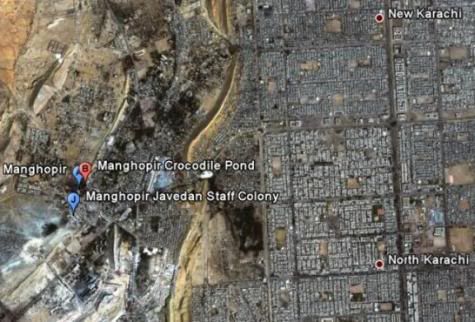
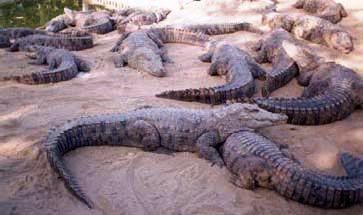 One of the vivid memories of my childhood is our family picnic visits to the Crocodile pond of Manghopir and then further to Hub Dam. For us children the Crocodile pond at Manghopir was always more fascinating than the calm lake of Hub Dam. Today, Manghopir pond is the largest colony of crocodiles in Pakistan. It is located in Northern part of Karachi. Google Earth map is given below.
Attractions at Manghopir:
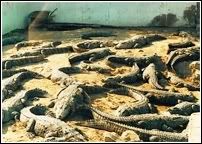 Manghopir is famous for three major attractions.
(1) The shrine of Saint Sakhi Sultan which is located on a hill at an altitude of approximately 600 ft.
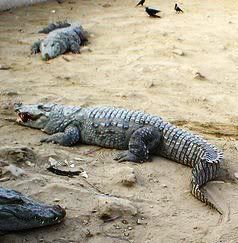
(2) Adjacent to the shrine is the second attraction in the form of a crocodile pond with a hundred plus docile crocodiles lying lazily there.
(3) A kilometer away from this shrine-crocodile pit complex is the third attraction in the form of hot water sulphur springs
Where is Manghopir Located:
It is located West of North Karachi, New Karachi and Surjani Town localities.
Who was Pir Mangho?
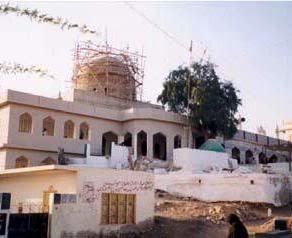
Who was Pir Mangho? This is a question shrouded in mystery which is laced with both myths and facts. The myths seem to have an upper hand on facts. Among all other things it is also not clear that who is actually buried in the shrine. Is it some saint called Sakhi Sultan or a saint called Mangho or are these two people one and the same person.
The photo to the right shows the shrine of Manghopir. I was able to find at least four legends describing the origins of Pir Mangho. I am however, not going to draw a conclusion on what legend seems right or wrong. I’ll leave that to our readership.
Legend One: The Tale of Mangho Wasa the Bandit
According to first legend, once there lived a bandit by the name of Mangho Wasa. He was notorious for looting caravans. Once the famous saint Baba Farid Ganj Shakar (AD 1173-1266) was passing near the present day Karachi on his way to perform Hajj (pilgrimage) in Mecca when Mangho Wasa looted him. This also brought Mangho in direct contact with Baba Farid. The divine sight and righteous personality of Baba Farid impressed Mangho Wasa so much that he converted to Islam. He became one of the disciples and started practicing sufism. Baba Farid was so pleased with Mangho that he titled him a saint (pir). Thus from that day onwards Mangho came to be known as Pir Mangho and the locality became famous as Manghopir. According to this legend, it is indeed Pir Mangho Wasa who is buried in the shrine and is now called Sakhi Sultan Manghopir.
Legend Two: Hazrat Khwaja Hasan Maroof Sufi Sakhi Sultan Baba
According to this legend says the person buried at Manghopir is infact Hazrat Khwaja Hasan Maroof Sufi Sakhi Sultan Baba (this got to be the longest name ever). When Mangho Wasa the bandit visited the shrine, he out of repentance for his sins, converted to Islam and served the wayfarers all his life. The shrine is now known as Manghopir in association of Mangho Wasa dacoit who turned into a pious soul in his later life. The person buried in the shrine is however Sakhi Sultan and not Mangho Wasa. Where is Mangho Wasa buried then? This legend is silent on that question.
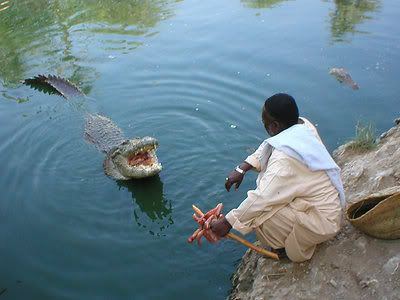
Legend Three: Pir Mangho of Arabia
The third legend says that Mangho came from Arabia in the 13th century. Soon after his arrival, he went into a meditation for 40 years in a nearby cave. He became popular as a saint because of the devotion he showed in his 40-year meditation and hence the people named him Pir Mangho. He is said to have lived to the age of 150. This legend is silent on why Mangho chose this area to go into a 40 year meditation.
Legend Four: Kamal Din’s Final Resting Place
Fourth legend comes from Alexander F Baillie’s book “Kurrachee: Past, Present and Future” where he writes: Pir Mangho is the proper designation of the shrine, to which Hindus and Muslims both resort in large numbers. It is sacred to the memory of a Saint, whose original name was Kamaldin, but whose designation was changed to that of Pir Mangho when his bones were removed to that place and interred under a mosque
The 100-Crocodile Pond:
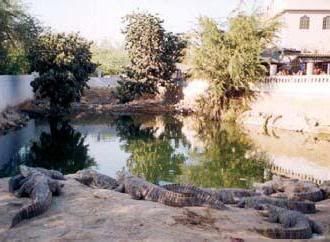 As if the origins of Pir Mangho were not mysterious enough, let us turn our attention to a 200 ft x 400 ft water pond adjacent to the shrine. Photo to the left shows this pond.
This pond is home to approximately 100 crocodiles.
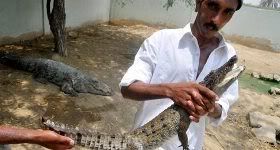 Salman Siddiqui writes about this pond in a Dawn article as:
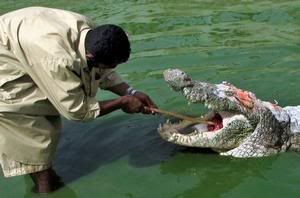
The crocodiles of Pir Mangho have never harmed a human being over their centuries of existence in a sanctuary near the shrine of the revered saint, claims Gaddi Nasheen (holy successor) Sajjad Sheedi (seen in the photo to the right in June 2009). To demonstrate this ‘fact,’ he readily jumps into the 400 feet long, 200 feet wide tank of green water filled with over a 100 cold blooded reptiles and comes out holding a three-year old baby croc to pose in front of the camera. Even as the eight-foot long mother croc comes towards us with an angry expression, the dare devil caretaker of the shrine remains calm and freezes the intended aggressor with just a sharp nudge of his stick, which he uses like a magic wand to control the wild beasts.
The Origin of Manghopir Crocodiles:
I was able to research at least 5 more legends and a scientific theory about how the crocodiles came to live in Manghopir area. I found some of the myths quite amusing. Make your own mind about any shade of truth in them.
(i) According to the first myth, Baba Farid Ganj Shakar gifted these crocodiles to Pir Mangho on his visit to the area. Why was Baba Farid traveling with crocodiles is unclear.
(ii) Second myth says that crocodiles were brought to Manghopir by a saint called Mor Mubarak (the blessed Peacock) from a cave in Korangi. Korangi is a Karachi town located some 50 km to the east of Manghopir.
(iii) Another version of the same myth says that Mor Mubarak had brought these crocodiles from a small brackish pit located in Waghodar area. Mor Mubarak tomb is also located in Waghodar, some 120 km upstream from Hub Dam. A perennial lake here still houses 10 marsh crocodiles that have been living here since Hub River flowed full. Therefore it is suggested that Manghopir crocodiles may have come downstream from here.
(iv) According to fourth myth, the famous saint of Sehwan Sindh, Lal Shahbaz Qalandar once visited the area. He was pained to see the area very inhospitable therefore with his miracles he caused a hot spring to issue forth as well as some date palms to spring up from the ground. The crocodiles were originally the lice in Lal Shahbaz’s hair which he gifted to Pir Mangho. He put them in the pond and each of them turned into a crocodile.
(v) The fifth myth, which I think is the most amusing, says that crocodiles were actually the lice in the hair of Pir Mangho. One day the lice were itching ‘pir sahib’ so much that in anger he stamped his feet on the ground and two sulfur pools were formed, in which the lice jumped and later grew up to become crocodiles.
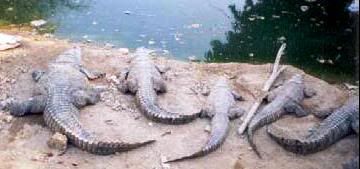
Some people have tried to give scientific explanation to crocodiles’ presence. These crocodiles were carried through some heavy floods, during ancient times and later gathered at this pond. Archaeological investigations have also suggested the existence of a Bronze Age settlement (2500-1700 BC) near Manghopir, who worshipped crocodiles.
Sohrab K. H. Katrak who was mayor of Karachi in 1942-43, in an essay about Karachi, writes about Manghopir in following words:
Twelve miles away from Karachi is a place called Magarpeer. It is a well-known swamp fed by a hot spring of reputed medical value. Adjoining it is a shrine of Pir Mangho, an ancient Mussalman saint, which is visited by hundreds of pilgrims every week. The swamp is filled with huge alligators (known as ‘muggers’), some forty in number. The name was changed from Pir Mangho to Mugger Pir during the British regime.About a mile from this pond of alligators is a Lepers’ Asylum, in the building of which a very prominent part was taken by Sadhu Navalrai and his son Sadhu Hiranand, the two celebrated saintly Sindhis of Hyderabad.
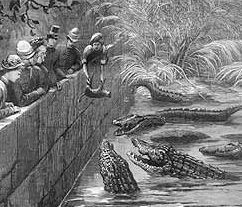 The image to the right shows live feeding of Manghopir crocodiles circa 1870s.
The Sheedis of Pakistan:
Karachi has a sizable population of people of African origin. They are the descendants of those slaves who were brought from Oman to Makran in the past. Later, recurring famine brought them liberty.
There are five main groups of Sheedi community in Pakistan. They are Lasi, Hyderabadi, Kharadari, Lasbela and Sheedis.
Every year theSheedis, the local name for Afro-Pakistanis, gather in Manghopir area, where they erect a temporary colony and live there for an entire week with their families and dance and sing in a festival called Sheedi jaat.
The Sheedi Jaat Festival at Manghopir:
The week long festival at Manghopir is called Sheedi Jaat. The date of the festival is decided with mutual consultation among notables of the five socio-cultural groups of the Sheedi tribe (named above) each year.
The festival is arranged in summer. For 2009, its dates were June 14 to June. The sheedi mela is very distinct from another festival at Manghopir which is the urs of the saint Sakhi Sultan. The urs happens in Islamic month of Zil-Hajj.
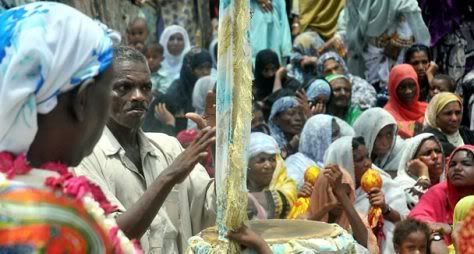
The photo above is courtesy of Fahim Siddiqui. It shows a glimpse of Sheedi jaat mela of 2009.
What Happens in Sheedi Jaat Festival?
The festival is a curious combination of solemn spiritual rituals and cultural celebrations. These include collective sessions of meditation accompanied by sacred lyrics often rendered by an elderly woman or man in a soulful voice, followed by dhamaal sessions.
 There are songs in a bizarre blend of Balochi, Urdu and Gujrati, with a few Swahili words, celebrating blackhood. Most of the songs contain the refrain of Sheedi Basha (read Badshah) meaning the black king. And, of course, with the singing comes dancing in typical African rhythms and African dance called Leva.
According to Salman Siddiqui’s research:
A procession of Sheedi women and men leave their homes at around noon each day and march towards the shrine to the sound of drumbeats. The parade is preceded by young boys holding four ‘Alams’ bearing a star symbol, which is reminiscent of the Muharram processions. But instead of the chest beating ‘Matam’ which the Shia community employs to express their mourning for the loss of Imam Hussain in Karbala, the Sheedis sing songs in Swahili to celebrate the happy occasion. The verses also contain a few phrases from the Urdu language
The festival revolves around the crocodiles confirming the participants’ African roots as crocodile worship was prevalent in the swamps and forests of Africa and still is among some tribes of Guinea and Zaire.
During the festival people make their pledges at the shrine of Pir Mangho through offering fresh meat (believed to be the sacrificial) to the crocodiles.
Respect Shown to Dead Crocodiles:
Sheedis believe that the crocodiles of Manghopir do not harm the saint’s followers. Owing to this belief, when a crocodile dies, it is buried with equal respect and formalities just as human being. There is also a reserved place for burying such dead crocodiles.
The Garlanding Ceremony of Mor Sahib:
 The highlight of the Manghopir festival is a garlanding ceremony, during which the Holy Successor (gaddi nasheen) puts a garland around the neck of the Chief of the Crocodiles called the Mor Sahib (Mr. Peacock). The image to the right shows feeding of Mor Sahib in 1878. He is 12 feet long. Besides ‘Mor Sahib’, the rest of the crocodiles are six to seven feet in length.
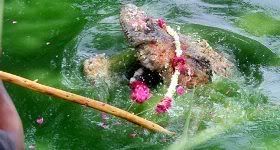 Success of this rite depends solely on the mood of old creature, but according to his keeper, he obliges most of the time and presents himself for the ritual. If the mood of Mor Sahib Crocodile is not so good then a bribe in the form of chunks of fresh meat does the trick. The meat offered to the crocodile is also not just any meat. It is chosen from the neck part of a goat, which is considered as the best meat.
Color and Sweets for the Crocodiles:
Crocodiles are also sprinkled with color and are served cooked food, halwa (sweetmeat) as a ritual. People here believe the crocodiles won’t attack them because they (crocodiles) are the disciples of Manghopir.
The annual festival provides the sheedis with an opportunity to strengthen their community ties and reaffirm their roots, although many of them are unaware of their African heritage and some deny that their ancestors were slaves and instead insist that they are descendants of black soldiers in the army of Mohammad Bin Qasim.
Thus what happens here may be described as some pagan rituals of worshipping crocodiles along with Islamic influence.
Crocodile Worship
According to Salman Siddiqui’s research:
The custom of offering food to crocodiles at shrines is not unique to Pakistan. A similar ceremony also takes place at the shrine of Khan Jahan Ali in Bangladesh. People make offerings to reptiles in many parts of South East Asia as well to ward off evil. There is also a tradition of worshipping crocodiles, which dates back to ancient times. In Egypt, people living by the river Nile used to worship Sobek, a god who had a human body but a crocodile head. Even today, this tradition is practiced by some tribes in parts of Africa.
In 1960s the population of crocodiles had dropped to just three. The pond in which they live had silted to a shallow depth of 3 feet and it was making crocodiles life miserable. Because of strong conservatory efforts of Wildlife conservation society of Pakistan the number of crocodiles has reached up to 100. Now the pit has become too small for them and many a times cannibalism ensues due to mutual fight for space and grabbing for food.
The Sulphur Spring of Manghopir:
Now to the third attraction of the area where sulphur springs are located a kilometer away from the shrine. 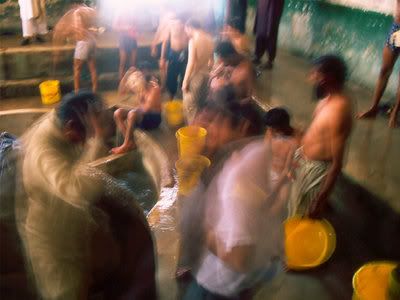 Warm water passing through the sulphur rocks contains some medicinal qualities and many people from long distances, with skin diseases regularly visit there to have a bath to cure them. There are separate swimming pools and shower rooms for men and women.
As of 2006 the ticket price of taking a bath here is Rupees 5.
Scientific analysis also show this warm water is naturally saturated with carbon dioxide, besides containing some sulphur and other skin friendly nourishments, which are no doubt suitable for many skin-diseased patients. The temperature of these sulfur ponds remains between 43C (110F) to 54C (130F). The photo to the right shows people taking bath in the sulfur springs
In 1963 a 200-bed hospital called the Marie Adelaide Leprosy Center was established nearby and it is to date the largest hospital of skin care in Karachi.
Photo Credits:
(i) Sheedi Mela Photos - Fahim Siddiqui, Dawn, June 18, 2009
(ii) Clicking on individual photos will take you to their source sites.
References:
(i) Crocodile Specialist Group Newsletter, Volume 23, No 3, July 2004 - September 2004.
(ii) Insight Guide Pakistan, Third edition 2000.
(iii) Karachi During the British Era - Two histories of a Modern City: Oxford University Press, 2007
(iv) Croc Fest - Salman Siddiqui, Dawn, June 18, 2009
(v) Google Earth
6/16/09
Asif Zardair ( Rich President of poor Country )
Asif Zardari’s - List of Local & International Wealth
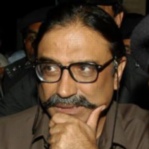
I have been in receipt of this extensive list of Asif Zardari’s Local and International holdings sent to me via a number of sources, in all honesty I have no way of precisely confirming the authenticity of this list but place it on this blog in an attempt to figure out what true what is simply hype. There is little doubt in my mind that this list may be quite close to being authentic considering the massive corruption that has plagued Pakistan in his previous two tenures in power, little to know that the Metamorphosis of 2008 which changed the way he appeared orchestrated after the assassination of his wife on 27th December 2007. Are we to believe in a ‘rejuvenated, honest by-the-books leader’, or are we gearing up to push Zardari further up into Pakistans Rich List of 2008 where he was previously ranked at #2.
I can also suspect that the sudden revelation if this list could be a deliberate retaliation by the ‘agencies’ to push Zardari on the back foot and move off Musharraf’s impeachment attack. Whatever be the case this massive list is jaw dropping amazing, I have no idea about the total valuation of the wealth itemized here but I suspect it could easily be an aggregated wealth as listed = £900m / ($1.8billion) or more
ZARDARI’S LOCAL ASSETS ARE:
1. Plot no. 121, Phase VIII, DHA Karachi.
2. Agricultural land situated in Deh Dali Wadi, Taluka, Tando Allah Yar.
3. Agricultural property located in Deh Tahooki Taluka, District Hyderabad measuring 65.15 acres.
4. Agricultural land falling in Deh 76-Nusrat, Taluka, District Nawabshah measuring 827.14 acres
5. Agricultural land situated in Deh 76-Nusrat, Taluka, District Nawabshah measuring 293.18 acres
6. Residential plot No 3 (Now House) Block No B-I, City Survey No 2268 Ward-A Nawabshah
7. Huma Heights (Asif Apartments) 133, Depot Lines, Commissariat Road , Karachi
8. Trade Tower Building 3/CL/V Abdullah Haroon Road, Karachi
9. House No 8, St 9, F-8/2, Islamabad
10. Agricultural land in Deh 42 Dad Taluka/ District Nawabshah
11. Agricultural land in Deh 51 Dad Taluka Distt Nawabshah
12. Plot No 3 & 4 Sikni (residential) Near Housing Society Ltd. Nawabshah
13. CafT Sheraz (C.S No.. 2231/2 & 2231/3) Nawabshah
14. Agricultural land in Deh 23-Deh Taluka & District Nawabshah
15. Agricultural property in Deh 72-A, Nusrat Taluka, Nawabshah
16. Agricultural land in Deh 76-Nusrat Taluka, Nawabshah
17. Plot No. A/136 Survey No 2346 Ward A Government Employee’s Cooperative Housing Society Ltd, Nawabshah
18. Agricultural land in Deh Jaryoon Taluka Tando Allah Yar, Distt. Hyderabad
19. Agricultural land in Deh Aroro Taluka Tando Allah Yar, Distt. Hyderabad
20. Agricultural land in Deh Nondani Taluka Tando Allah Yar, Distt. Hyderabad
21. Agricultural land in Deh Lotko Taluka Tando Allah Yar, Distt. Hyderabad
22. Agricultural land in Deh Jhol Taluka Tando Allah Yar, Distt. Hyderabad
23. Agricultural land in Deh Kandari Taluka Tando Allah Yar, Distt. Hyderabad
24. Agricultural land in Deh Deghi Taluka Tando Mohammad Khan
25. Agricultural land in Deh Rahooki Taluka, Hyderabad
26. Property in Deh Charo Taluka, Badin
27. Agricultural property in Deh Dali Wadi Taluka, Hyderabad
28. Five acres prime land allotted by DG KDA in 1995/96
29. 4,000 kanals on Simli Dam
30. 80 acres of land at Hawkes Bay
31. 13 acres of land at Maj Gulradi ( KPT Land )
32. One acre plot, GCI, Clifton
33. One acre of land, State Life ( International Center , Sadar)
34. FEBCs worth Rs. 4 million
SHARES IN SUGAR MILLS INCLUDE:
1. Sakrand Sugar Mills Nawabshah
2. Ansari Sugar
3. Mills Hyderabad
4. Mirza Sugar Mills Badin
5. Pangrio Sugar Mills Thatta
6. Bachani Sugar Mills Sanghar
FRONT COMPANIES IN FOREIGN COUNTRIES:
1. Bomer Fiannce Inc, British Virgin Islands
2. Mariston Securities Inc, British Virgin Islands
3. Marleton Business S A, British Virgin Islands
4. Capricorn Trading S A, British Virgin Islands
5. Fagarita Consulting INc, British Virgin Islands
6. Marvil Associated Inc, British Virgin Islands
7. Pawnbury Finance Ltd, British Virgin Islands
8. Oxton Trading Limited, British Virgin Islands
9. Brinslen Invest S A, British Virgin Islands
10. Chimitex Holding S A, British Virgin Islands
11. Elkins Holding S A, British Virgin Islands
12. Minister Invest Ltd, British Virgin Islands
13. Silvernut Investment Inc, British Virgin Islands
14. Tacolen Investment Ltd, British Virgin Islands
15. Marlcrdon Invest S A, British Virgin Islands
16. Dustan Trading Inc, British Virgin Islands
17. Reconstruction and Development Finance Inc, British Virgin Islands
18. Nassam Alexander Inc.
19. Westminster Securities Inc.
20. Laptworth Investment Inc 202, Saint Martin Drive, West Jacksonville
21. Intra Foods Inc. 3376, Lomrel Grove, Jacksonville , Florida
22. Dynatel Trading Co, Florida
23. A.. S Realty Inc. Palm Beach Gardens Florida
24. Bon Voyage Travel Consultancy Inc, Florida
ZARDARI’S PROPERTIES IN UK ARE:
1. 355 acre Rockwood Estate, Surrey (Now stands admitted)
2. Flat 6, 11 Queensgate Terrace, London SW7
3. 26 Palace Mansions, Hammersmith Road , London W14
4. 27 Pont Street , London , SW1
5. 20 Wilton Crescent , London SW1
6. 23 Lord Chancellor Walk, Coombe Hill, Kingston , Surrey
7. The Mansion, Warren Lane, West Hampstead, London
8. A flat at Queensgate Terrace, London
9. Houses at Hammersmith Road, Wilton Crescent , Kingston and in Hampstead.
ZARDARI’S PROPERTIES IN BELGIUM ARE:
1. 12-3 Boulevard De-Nieuport, 1000, Brussels , (Building containing 4 shops and 2 large apartments)
2. Chausee De-Mons, 1670, Brussels
ZARDARI’S PROPERTIES IN FRANCE ARE:
1. La Manoir De La Reine Blanche and property in Cannes
ZARDARI’S PROPERTIES IN USA — in the name of Asif Zardari and managed by Shimmy
Qureshi are:
1. Stud farm in Texas
2. Wellington Club East, West Palm Beach
3. 12165 West Forest Hills , Florida
4. Escue Farm 13,524 India Mound, West Palm Beach
5. 3,220 Santa Barbara Drive , Wellington Florida
6. 13,254 Polo Club Road, West Palm Beach Florida
7. 3,000 North Ocean Drive , Singer Islands , Florida
8. 525 South Flager Driver, West Palm Beach , Florida
9. Holiday Inn Houston Owned by Asif Ali Zardari, Iqbal Memon and Sadar-ud-Din Hashwani
ZARDARI’S BANK ACCOUNTS IN FOREGN COMPANIES ARE:
1. Union Bank of Switzerland (Account No. 552.343, 257.556.60Q, 433.142.60V, 216.393.60T)
2. Citibank Private Limited (SWZ) (Account No. 342034)
3. Citibank N A Dubai (Account No. 818097)
4. Barclays Bank (Suisse) (Account No. 62290209)
5. Barclays Bank (Suisse) (Account No. 62274400)
6. Banque Centrade Ormard Burrus S A
7. Banque Pache S A
8. Banque Pictet & Cie
9. Banque La Henin, Paris (Account No. 00101953552)
10. Bank Natinede Paris in Geneva (Account NO.. 563.726.9)
11. Swiss Bank Corporation
12. Chase Manhattan Bank Switzerland
13. American Express Bank Switzerland
14. Societe De Banque Swissee
15. Barclays Bank (Knightsbridge Branch) (Account No. 90991473)
16. Barclays Bank, Kingston and Chelsea Branch, (Sort Code 20-47-34135)
17. National Westminster Bank, Alwych Branch (Account No. 9683230)
18. Habib Bank ( Pall Mall Branch).
19. National Westminster Bank, Barking Branch, (Account No. 28558999).
20. Habib Bank AG, Moorgate, London EC2
21. National Westminster Bank, Edgware Road , London
22. Banque Financiei E Dela Citee, Credit Suisse
23. Habib Bank AG Zurich , Switzerland
24. Pictet Et Cie, Geneva
25. Credit Agricole, Paris
26. Credit Agridolf, Branch 11, Place Brevier, 76440, Forges Les Faux
27. Credit Agricole, Branch Haute – Normandie, 76230, Boise Chillaum
Subscribe to:
Posts (Atom)


 English Newspapers


 Dars-e-Quraan
 Dr. Israr Ahmad