Showing posts with label Pak Cricket. Show all posts

9/27/09

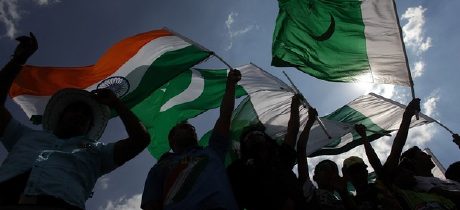
Waoo Pakistan Wins Over India in Champions Trophy

Game Update: Pakistan won the match by 54 runs. Shoaib Malik named Man of the Match.
The thrill of a Pakistan-India cricket encounter is always special. This time around at the ICC Champions Trophy Tournament in South Africa it is no different.

The story of the moment is that Pakistan has set India 303 to win. A good score but certainly not insurmountable. At the time of writing this, India was 91/2 in 14 overs, in the 50 overs game (current score here).

Earlier report on Pakistan’s innings, from The News:

An enterprising century by Shoaib Malik and brilliant 87 by Mohammad Yousuf helped Pakistan set India a difficult target of 303 runs in their Group A match in the ICC Champions Trophy here on Saturday. Malik made 128 from 126 balls and struck 16 fours while Yousuf hit seven fours in his 88-ball innings. Both added 206 runs, a record fourth wicket partnership against India. For India, seamers Ashish Nehra bagged four wickets for 55 runs while Ishant Sharma claimed two for 39. Pakistan captain Younus Khan elected to bat after winning the toss against India in the Champions Trophy here on Saturday.
Pakistan won their opening match of the four-team group against the West Indies, while India are playing their first game. Defending champions Australia are the other team in the group, with the top two advancing to the semi-finals. Pakistan made one change from the side that beat the West Indies, with Younus coming in place of Misbah-ul-Haq.
Pakistan: Younus Khan (captain), Imran Nazir, Kamran Akmal (wk), Shoaib Malik, Mohammad Yousuf, Umar Akmal, Shahid Afridi, Rana Naved-ul Hasan, Umar Gul,
Mohammad Aamer, Saeed Ajmal
India: Mahendra Singh Dhoni (captain & wk), Sachin Tendulkar, Gautam Gambhir, Rahul Dravid, Suresh Raina, Virat Kohli, Yusuf Pathan, Harbhajan Singh, Ishant Sharma, Ashish Nehra, Rudra Pratap Singh.

Bookmark and Share

Read more...

8/9/09

in 1982 a Cold Wintet Day

A while ago, we had a post about the experience of a young cricket fan watching his very first International match at National Stadium Karachi. Today’s post is about the similar experience at Qazzafi Stadium Lahore that happened on the cold frigid day of December 31, 1982.

India’s cricket team was touring Pakistan in 1982-83 to play 6 test matches and 4 One Day Internationals. This was one of the most important cricket series‘ of the 80s.


Javed Miandad writes about this series in his bioagraphy as:

Infact, in that 1982-83 home season, the nucleus of the Pakistan team that would go on to dominate the world in the 1980s was starting to take shape.

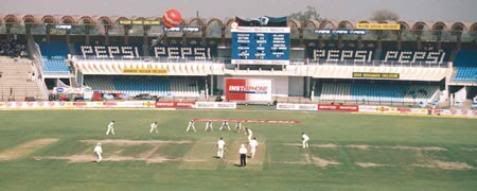
One of the ODIs of this series was scheduled in Lahore on December 31, 1982. I was in Lahore in those days. A cousin of mine and myself decided to go to the stadium and watch the match. Our tickets were for the roof covered Club Enclosure towards the College-end. The enclosure is visible in the photo above, just next to the sight screen - towards right side.

On the morning of the match it started to rain in Lahore. Since we had to sell tickets so on that frigid Lahore winter morning, we reached the stadium around 7 a.m. People had already started to pour in the stadium.

Due to morning rains, the match was reduced to 33-over-a-side. Imran Khan won the toss and elected to bat. Cricketer-turned-Film Star Mohsin Khan and Mudassar Nazar started the innings for Pakistan and Kapil Dev started bowling for India. His first ball was a wide but on very next ball he caught-and-bowled Mohsin Khan for 0. There was a sudden silence in the stadium, which was by then jam-packed with over 35000 people. Zaheer Abbas came to bat next. Zaheer and Mudassar Nazar steadily took the score to 70 when Mudassar fell caught-and-bowled to Ravi Shastri. Javed Miandad came to bat next.

At some point in the match a section of the crowd became rowdy to cricketer Balvinder Singh Sandhu. He complained to umpires and the match was stopped. Javed Miandad came towards the crowd and beckoned the crowd by putting put his finger on his lips. The whole crowd became as silent as dead. Such was the power of cricket superstars in those days. There was no crowd trouble after that for rest of the day.

Zaheer and Javed were both at the top of their batting form. They hit, drove, pulled and cut at will. Mohindar Amarnath who always bowled with a Red handkerchief in his pocket for Good omen was smashed all over the ground by Javed-Zaheer duo for 50 runs off 5 overs. Kapil Dev went for 73 runs off his 7 overs.

When 33 overs finished, Pakistan scored 252 for 3. Javed Miandad was not out at his career best 119 off 77 bowls, with 5 sixes. Zaheer Abbas scored 105 off 82 bowls. I think I am fortunate to have seen Javed Miandad playing his career best innings live.

After lunch break Sunil Gavaskar and Kishnamachari Srikkanth started the innings for India. It was Srikkanth’s third one-day match and not many people knew him then. Imran Khan started bowling for Pakistan but was hammered by Srikkanth in his first over for 2 sixes out of the ground on mid-wicket. The mid-wicket boundary in Qazzafi stadium is full 75 yards, plus some extra yards behind that, and then a huge general enclosure. So those were some really giant hits by Srikkanth that went out of the stadium. The crowd was silent again. Nobody could grasp that a new kid named Srikkanth could hit 2 consecutive sixes to Imran Khan. When Imran came for his 32-step bowling start near our enclosure, someone in the crowd started shouting ‘Oyay Oyay’. Imran looked at the crowd and with hand gestures asked them to clap for Srikkanth.

When Pakistan off-spinner Ijaz Faqih came to bowl, I remember the crowd was shouting

Ijaz saada sher eh, (Our Ijaz is the lion)
dum lagaan di der eh (Only thing missing is his tail)

Pakistan’s bowling attack in those days used to rely solely on Imran. Checkout the bowling line of Pakistan in that match: Imran Khan, Tahir Naqqash (he used to circle his arm 5 times before actually delivering the ball), Shahid Mahboob (him and Rashid Khan, used to bowl on wrong foot, remember?), Ijaz Faqih (theoretically an off-spinner but practically a straight slow flighted lolly-popper), and our Lord’s hero (1982), the man with the golden arm, Mr. Mudassar Nazar.

Finally Srikkanth (39) was out caught while going for a big hit on Shahid Mahboob. Gavaskar(69) was removed by Tahir Naqqash. Sandeep Patil scored 51. When 27 overs finished, India were 193/4 and required 62 to win in 6 overs. At that instance rain came again, and India won the match on better run rate because Pakistan’s score at the end of 27th over were 175/2. It was a big disappointment for the crowd because had the match went up to 33 overs, it would’ve been very difficult for India to score 62 off 36 bowls, especially with 2 overs of Imran Khan remaining. It was the peak season of Imran Khan and during the same series later on he got his famous stress facture. Javed recalls this series of Imran in following words in his biography:

Imran, (in this series) was phenomewnal and bowled some of the best spells of his career, taking 40 wickets for 13.95 a piece. His famous afternoon spell in Karachi during the second Test - where he brought down India from 102-1 to 114-7 with reverse-swinging boomerangs - is one of the most famous spells of bowling in Pakistan cricket. It was just out of this world.

After the match we came back with a ‘latka hoa muNh’ (long face) because Pakistan had lost the match. But I’ll always remember this match for Javed Miandad and Zaheer Abbas batting.

Next week I came back to Karachi, and watched the 4th one-day at National Stadium Karachi. That story some other time.


Bookmark and Share

Read more...

5/21/09

Inspiration Pakistan: The Pakistani Spirit Lives

Let's have a quick game

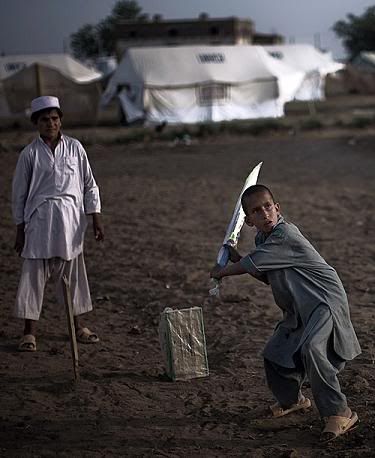
Just saw this image published at a cricketing website with the caption:

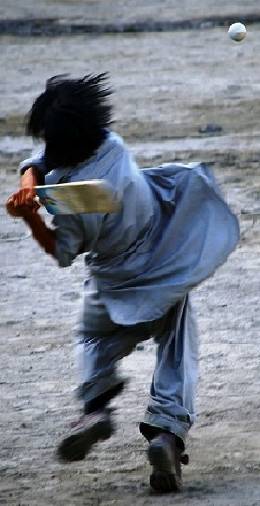
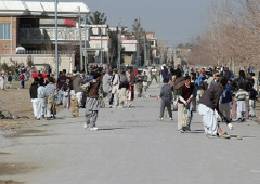
Homeless children play cricket after being displaced by the Taliban, Swabi, Pakistan.

I say, while in Pakistan, they are not homeless.They are displaced from warm holdings of a house to harsh surroundings. Internally Displaced Persons(IDPs). They are not homeless because Pakistan is their home. And ours.Which is why we should think of their displacement as our own. Fell their hurt as our own. See their struggles as our own. All Things Pakistan (ATP) has setup a way for expats to quickly contribute towards this larger cause. Please do your bit, if you have not already.

After silence of months to aid these IDPs, fortunately, media is speaking now. Please come forward to help our fellow Pakistanis who are displaced from their homes, for us. Lets join hands to have our beautiful lands back. Inshah Allah.


Bookmark and Share

Read more...

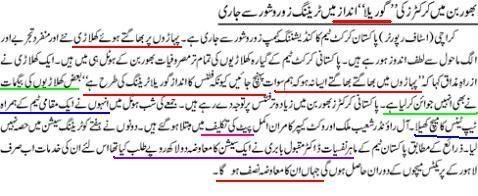
Pak Cricketers, Bhurban and ‘gorilla andaaz‘

To prepare for upcoming Twenty-20 World Cup, Pakistan Cricket Team’s training session is going on in Bhurban hill resort. Pakistan’s largest Urdu Daily, Jang has this interesting take on the event.


Bookmark and Share

Read more...

4/23/09

Cricket and Islam: A Brewing Controversy

According to a Reuters report (CricInfo version here) Pakistan cricket players have “been advised to strike a balance between religion and cricket.” This according to Dr. Nasim Ashraf, the new Chairman of the Pakistan Cricket Board (PCB).

The report goes on to say:

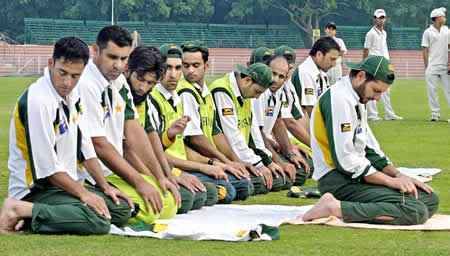
Since last year, the Pakistan team has made it a point to pray in public and hold religious gatherings in team hotels. Ashraf said in a television interview he did not believe there was any connection between Maulvism, ultra orthodox Muslims, and cricket. “There is no doubt their religious faith is a motivating factor in the team. It binds them together. But there should be balance between religion and cricket,” Ashraf said.

Captain Inzamam-ul-Haq, batsman Mohammad Yousuf, who converted to Islam from Christianity earlier this year and former leg-spinner Mushtaq Ahmed have been in the forefront of projecting a religious image of the team. Ashraf said he had no problems with the players saying their prayers regularly but he had told Inzamam that Islam does not allow the imposition of views on others.

“I have told him clearly that there should be no pressure on players who don’t pray regularly or any compulsion on them to do it under pressure,” he said. “I have told him there should be no perception among players that if they don’t pray they will not be in the team… He has assured me there is no pressure on anyone to do anything they don’t want to do. I have also told him players should get proper rest for their cricket,” Ashraf added.

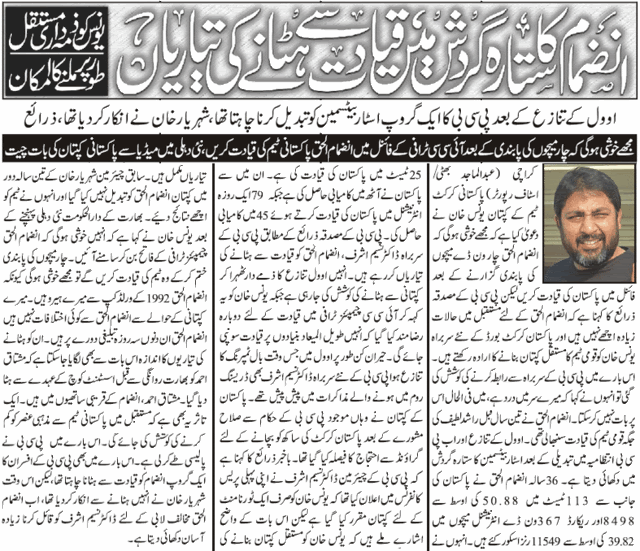
The report does not come as a surprise (click on image to see story from Jang, 9 October), but it is still a bit of a shock.

I do not like the word ‘Maulvisim’. I do not know what it means, and whether that was the intent or not, it is likely to be seen as a slur and a coded attack. I worry greatly these days about an increasing tendency to use polarizing language, the use of which can only spell trouble in an already much-fractured society. I am hoping that it is a word coined by an over-eager Reuters reporter and not Dr. Nasim Ashraf.

I should add that I have known Doctor Sahib for some years. I know that personally he is a man of strong personal faith and religious conviction and for that reason alone I think he would be well suited to have discussions with the team on these issues in ways that others might not be able to. But such discussions are intensely personal and should remain private (but not secret). Please note that I am not calling for secrecy, but I do not think that Reuters wire services or television airwaves are the best medium for this conversation. I fear that in the glaring lights of the media circus , this important conversation will necessarily become polarized, simplistic, and accusatory and will degenerate towards crass finger-pointing, self-righteous chest-thumping, and loud but hollow sloganeering.

I should thank Adnan Siddiqi’s blog (here) for first alerting me to this brewing controversy. Since then I have tried to keep a tab on this issue. Today, Teeth Maestro also has a commentary on his blog (here). My own views on this stem from the very same logic that had influenced my views on the story about Habib Bank requiring employees to trim their beards which I had commented on in the very earliest weeks on this blog (here). The parallels between the two are strikingly similar, but so are the principles:

  • First, no one has the right to restrict anyone’s else’s right to personal expressions of belief and faith, no matter what that belief or faith might be.

It would be wrong, therefore, if PCB, ICC, or anyone else were to restrict the expression of personal faith by any set of players. Whether it is saying one’s prayers in public and in jamaat or growing a beard, that is a matter of personal choice. One’s inclusion in the team should not be a matter of whether one has (or does not have) facial hair. It should depend solely and only on one’s cricketing abilities. Despite the headline statement, a careful reading of the news item above suggests that the PCB is acknowledging that faith is a key “motivating factor” for this team and is not asking anyone to either restrict their beliefs or the expression of those beliefs. If it were ever to do so, it would be a matter of grave and serious concern indeed.

  • Second, and relatedly, no one has the right to impose their own religious beliefs on others through direct or indirect pressure.

It would be wrong, therefore, if senior players were somehow pressurizing or forcing teammates to adopt a particular behavior. To repeat what I have already said above: One’s inclusion in the team should not be a matter of whether one has (or does not have) facial hair. It should depend solely and only on one’s cricketing abilities. A careful reading of the news item above makes clear that Inzimam, at least, understands that there should be (and is) no such pressure. If any players were ever to feel pressurized by the religious beliefs of their team-mates or were made to feel that their continued inclusion in the team would depend on their praying habits (rather than their playing abilities), then - and only then - it would be a matter of grave and serious concern indeed.

My only hope right now is that the media circus - in Pakistan and abroad - will not sensationalize this important issue and force even greater fissures and polarizations than already exist. I fear that this hope will not be realized.

But let me also say that I have much greater confidence in Inzimam, his teammates and Dr. Nasim Ashraf and pray that they will resist the media’s provocations and will refuse to fall into petty bickering or sloganeering opportunities.


Bookmark and Share

Read more...

4/21/09

Shoaib Akhtar - A Fallen Hero?

Raza Rumi

I am not concerned with the technicalities of Shoaib Akhtar’s sentence, which have been the subject of much debate across Pakistan and indeed wherever cricket is played and followed. There have been some avoidable outbursts by both Akhtar and his disciplinarians. Akhtar has a chequered past in the conventional sense; and perhaps his tragic flaw is the cavalier attitude that is now a hallmark of his persona. But he is a star whose talent has done cricket, Pakistan, and Pakistanis proud. The quantum of punishment given to him has therefore been viewed as some sort of betrayal, and many have termed it unfair. But this is now a sub judice matter and so cannot be commented upon any further.

However, what lies underneath the narrative of Shoaib Akhtar’s plight relates to the sociological and attitudinal trends that have now engulfed Pakistan, like a poisonous creeper that consumes even the best kept plants in a garden.
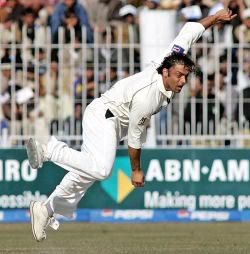
Shoaib Akhtar is self-made, rising from humble origins into the global limelight. Born at Morgah, a small town near Rawalpindi, on August 13 1975, he is the youngest of four sons (he also has a younger sister) of an oil refinery worker. Far from following in his father’s footsteps, however, Akhtar began to show cricketing talent while still at school. It was at Asghar Mall College, during his twenties, that his extraordinary skill at the game was recognised; he played at increasingly high levels (including a spell for the English team Worcestershire), culminating in his selection for the national team in 1997. He then shot to international fame during the 1999 World Cup. Stunning spectators with his bowling ability, he went on to set the world record for bowling speed at 100.2 mph, where it still stands.

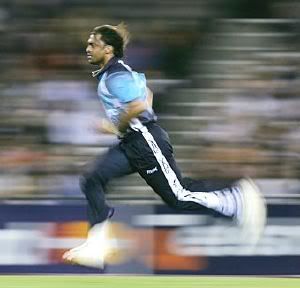
Nicknamed “The Rawalpindi Express,” Akhtar’s performance in the 1999 World Cup meant that he suddenly became a household name in Pakistan. The immense run-up, the hurtling legs, the characteristic flop of the hair: every young man on the Pakistani streets wanted to be Shoaib Akhtar. It is clear, however, that he belongs to no family or cartel of cricketers. Through this transition to stardom, Akhtar’s attitude reflected his independence and self-reliance, his use only of his own abilities, strengths and skills. Until now, he has defied the sport’s entrenched culture of patronage, and therefore has neither sought, nor benefited from, it. Hence his troubled relations with the authorities, and his reluctance to follow the ingrained feudal culture of obedience, have found resonance with a changing Pakistan.

It is not just the issue of patronage; not unlike the vast majority of Pakistanis, Shoaib Akhtar has been avowedly secular in his views and personal life. The Pakistani team that was almost invaded by preaching brigades, and ultimately indulged in displays of public piety from the PIA flights to the cricket grounds, did not find much sympathy in Akhtar’s view of the world. While many of his former associates were growing beards and following a particular sectarian version of Islamic piety, Akhtar was busy partying whenever and wherever he wanted. So an outcast had already been defined.

Asked in an interview with an Urdu newspaper whether he was religious, he replied: “Islam is our faith and integral to our lives; however, I do not believe in imposing it on others and also dislike wearing it on your sleeve.” In most public statements he has expressed his belief in God but stayed away from the public dimension that we have all been cursed with since General Zia ul Huq’s destruction of Pakistani society.
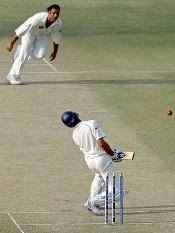
However the greatest breach of proprietary is Akhtar’s friendliness to India and Indians despite his proud Pakistani identity; he has never been shy of befriending the Indians, from Bollywood stars to common people on the street and in the stadiums. The legendary image of Shoaib Akhtar picking up the cap of an Indian policeman in a cricket ground and wearing it says much more than various rounds of composite dialogue and is perhaps the most forceful display in recent times of clichéd “people-to-people contact.” Akhtar is playful, casual and yet inherently dangerous. He goes too far, breaking the barrier well before officialdom has made the leap.

After all, he is playing for the Indian League; he is working with Shahrukh Khan on a film; and he is involved in charity programmes for special children. Not to mention that he races - shirtless at that - with another star, Salman Khan, under the media’s glare.

The middle class morality surrounding him has also been hyped beyond belief. A few random pictures of Akhtar from the foreign press standing in a jovial party mood with some girls have been stretched beyond reasonable limits and commented on out of context. Perhaps the media that flashes these pictures time and again forgets that this sort of contact between men and women is in most societies a routine affair; and more often than not has none of the sexual or immoral connotations that the custodians of public morality would have us believe.

His statements against fundamentalism, for instance his remark that Islam is not practiced with beards alone, must be too much to handle when many of his colleagues sport unwieldy beards. We know that the Pakistan Cricket Board has taken cognizance of the players’ public displays of religiosity in the past, but the reality is that the influence of tableeghis now permeates Pakistan’s corridors of power, including its high-profile cricket team.

Shoaib Akhtar’s character assassination is worrying. Those of us who want the pluralist, secular Pakistan envisaged by the Quaid-e-Azam feel upset when the personal life of a player becomes as important as his performance. And those of us who believe that we need to be at peace with our neighbours - especially India - are also concerned. Any deviation from the ends of peace and coexistence with our larger neighbour would be suicidal; and stars like Shoaib are the best confidence building measure we can think of these days.

While the sentence awarded by the Board needs to be respected – a need germane to the much talked about “rule of law” these days - one cannot help but sympathise with the predicament of Shoaib Akhtar. Therefore, while we shall lament his acts of indiscipline if they are finally proved, we will always respect Akhtar for his talent and praise him for being a beacon in the darkness of extremism.


Bookmark and Share

Read more...

4/16/09

Remembering Tikanjoo

I grew up playing cricket on the street. After asr (late afternoon) prayers, I was usually the first one to put wicket in the center of the street, mark creases with a chalk, and put a stone as the bowling mark. I also used to put new tape on balls and did some other management stuff…
(Photo to the right is of a street cricket player from Chitral, Pakistan.)

…Slowly other boys from the neighbor hood would come out and numbering was done to decide who would bat first. In those early minutes of set up, a boy from the neighborhood helped me a lot. He was employed in one of the homes and used to get a permanently bald cut from the local barber. So people started calling him ‘ganja’. Some with lesser formal education used to call him ‘takloo’ (it means a bald person in local Karachi slang)

After a Hajj season our cricket team suddenly got some Haji players who had recently became ‘ganja’ (bald) after performing the holy ritual.

This caused a big confusion in our local team on how to distinguish between so many bald players while using some kind of slang language. In those days of early youth, using proper literary language was considered so out of fashion……

……After many days of deliberation we called a ’shoora’ (cabinet) meeting of neighborhood boys and in that meeting it was unanimously decided to name the original

ganja guy as ‘Tikanjoo’.

The logic behind this nomenclature was:

Ganja + Takloo = Tikanjoo

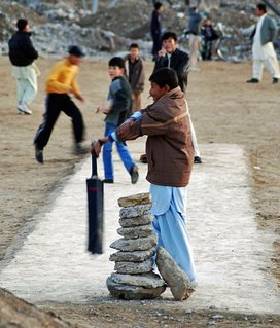
(Photo to the left is from Quetta, Pakistan and it shows ingenuity of players who have built the cricket wicket by stacking up stones.)

Tikanjoo had great passion for cricket. He would come out on the street earlier than me. Sometimes I saw him waiting for me to put wickets on the street so that he can get a break from his employers and come out to play. I would then send him to all the homes in neighborhood to ring call bells and ask the ‘V.I.P cricketers’ to come out.

Tikanjoo bowled really fast jerk balls. Just like Shoaib Akhtar he would run 32 steps and then throw cricket ball like a stone with out circling his arm over. To get a better picture, imagine Shoaib Akhter bowling in a fluttering 9 feet long ’shalwar qameez’ and wearing Bata’s ‘hawaai chappal’ (flat open slip-ons). ….

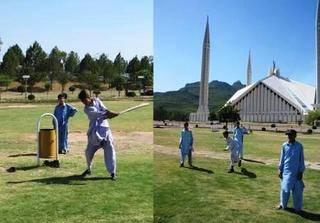
(I took this photograph in June 2005. Temperature at that time was 45 degree centigrade and I am not kidding. It shows the passion of cricket in Islamabad, Pakistan. These players are using a trash can as the wicket.)

…Poet Zameer Jaffri once said a ’sher’ about the West Indian fast bowler Wes Hall which perfectly fits the way Tikanjoo used to bowl in our steet. It goes like this:

shor uTha ke Hall aatat hai, khel ka intaqaal aata hai
Hall se pehlay ball aati hai, ball se pehlay Hall aata hai

If any batsman didn’t get out with technically correct bowling then we used to bring Tikanjoo to throw few balls. Due to incorrect bowling action of Tikanjoo, batsmen would usually complain that this act was an ‘ochaa hath-kanDaa’ (cheap stunt) on part of fielding side but to no avail. After ‘Tikanjoo’ was unleashed then more often than not, he would get the wicket of well set batsman.

As a rule of street cricket, a direct hit in neighbourhood homes was considered out…

(Photo to the right is from Quetta, Pakistan. It shows multiple cricket games going on at the same street.)

…. If someone got out in such manner, we used to request Tikanjoo to be a useful member of the team and prove his loyalty by bringing back the ball. He would then climb walls, climb window shades, reach roofs in no time and retrieve the ball for us.

Then one day Tikanjoo found work in another neighborhood and left our locality. He was talked about for few days and then everyone forgot about him. We grew up into our current roles of life. Nobody knows what happened to Tikanjoo after few months. Reminds me of this sher:

mohallay waalay na-haq khafa ho gayay warna
woh to ek andaaz tha os kay pyar karne ka

I hope wherever is Tikanjoo, he is fine and enjoying the cricket as much as he did in our childhood. At this moment I don’t even recall his real name but I just thought about him and it brought smile to me and thus I wanted to share above lines with you. Long live cricket and long live Pakistan.
(Photo to the above left is our street in Federal-B-Area, Karachi - Jan 2007 - where Tikanjoo used to bowl his super fast throws. The street looks deserted without a cricket wicket in the center and all the care free boys of yesteryears having grown up into men with responsibilities.)

Before ending this post, I also want to share a ’sher’ which my friend Amjad Hussain first told me:

jab cricket khela kartay the, osay wicket banaaya kartay the
hum jis se pani peetay the, woh maTka aakhir TooT gaya


Bookmark and Share

Read more...

3/29/09

Remembering Tikanjoo

I grew up playing cricket on the street. After asr (late afternoon) prayers, I was usually the first one to put wicket in the center of the street, mark creases with a chalk, and put a stone as the bowling mark. I also used to put new tape on balls and did some other management stuff…

(Photo to the right is of a street cricket player from Chitral, Pakistan.)

…Slowly other boys from the neighbor hood would come out and numbering was done to decide who would bat first. In those early minutes of set up, a boy from the neighborhood helped me a lot. He was employed in one of the homes and used to get a permanently bald cut from the local barber. So people started calling him ‘ganja’. Some with lesser formal education used to call him ‘takloo’ (it means a bald person in local Karachi slang)

After a Hajj season our cricket team suddenly got some Haji players who had recently became ‘ganja’ (bald) after performing the holy ritual.

This caused a big confusion in our local team on how to distinguish between so many bald players while using some kind of slang language. In those days of early youth, using proper literary language was considered so out of fashion……

……After many days of deliberation we called a ’shoora’ (cabinet) meeting of neighborhood boys and in that meeting it was unanimously decided to name the original

ganja guy as ‘Tikanjoo’.

The logic behind this nomenclature was:

Ganja + Takloo = Tikanjoo

(Photo to the left is from Quetta, Pakistan and it shows ingenuity of players who have built the cricket wicket by stacking up stones.)

Tikanjoo had great passion for cricket. He would come out on the street earlier than me. Sometimes I saw him waiting for me to put wickets on the street so that he can get a break from his employers and come out to play. I would then send him to all the homes in neighborhood to ring call bells and ask the ‘V.I.P cricketers’ to come out.

Tikanjoo bowled really fast jerk balls. Just like Shoaib Akhtar he would run 32 steps and then throw cricket ball like a stone with out circling his arm over. To get a better picture, imagine Shoaib Akhter bowling in a fluttering 9 feet long ’shalwar qameez’ and wearing Bata’s ‘hawaai chappal’ (flat open slip-ons). ….

(I took this photograph in June 2005. Temperature at that time was 45 degree centigrade and I am not kidding. It shows the passion of cricket in Islamabad, Pakistan. These players are using a trash can as the wicket.)

…Poet Zameer Jaffri once said a ’sher’ about the West Indian fast bowler Wes Hall which perfectly fits the way Tikanjoo used to bowl in our steet. It goes like this:

shor uTha ke Hall aatat hai, khel ka intaqaal aata hai
Hall se pehlay ball aati hai, ball se pehlay Hall aata hai

If any batsman didn’t get out with technically correct bowling then we used to bring Tikanjoo to throw few balls. Due to incorrect bowling action of Tikanjoo, batsmen would usually complain that this act was an ‘ochaa hath-kanDaa’ (cheap stunt) on part of fielding side but to no avail. After ‘Tikanjoo’ was unleashed then more often than not, he would get the wicket of well set batsman.

As a rule of street cricket, a direct hit in neighbourhood homes was considered out…

(Photo to the right is from Quetta, Pakistan. It shows multiple cricket games going on at the same street.)

…. If someone got out in such manner, we used to request Tikanjoo to be a useful member of the team and prove his loyalty by bringing back the ball. He would then climb walls, climb window shades, reach roofs in no time and retrieve the ball for us.

Then one day Tikanjoo found work in another neighborhood and left our locality. He was talked about for few days and then everyone forgot about him. We grew up into our current roles of life. Nobody knows what happened to Tikanjoo after few months. Reminds me of this sher:

mohallay waalay na-haq khafa ho gayay warna
woh to ek andaaz tha os kay pyar karne ka

I hope wherever is Tikanjoo, he is fine and enjoying the cricket as much as he did in our childhood. At this moment I don’t even recall his real name but I just thought about him and it brought smile to me and thus I wanted to share above lines with you. Long live cricket and long live Pakistan.

(Photo to the above left is our street in Federal-B-Area, Karachi - Jan 2007 - where Tikanjoo used to bowl his super fast throws. The street looks deserted without a cricket wicket in the center and all the care free boys of yesteryears having grown up into men with responsibilities.)

Before ending this post, I also want to share a ’sher’ which my friend Amjad Hussain first told me:

jab cricket khela kartay the, osay wicket banaaya kartay the
hum jis se pani peetay the, woh maTka aakhir TooT gaya


Bookmark and Share

Read more...

Classroom Cricket: Simple Pleasures

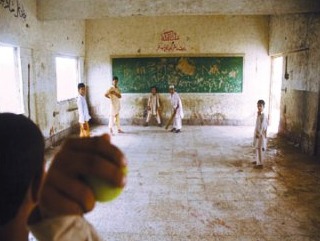
This picture depicts the simple pleasures of youth, but also a sad reality.

Here are children playing cricket in a class room of an abandoned school, in Sector 4 of Korangi, Karachi. This photo appeared in the daily Dawn of September 14, 2008.

The sad part is that this school was completed in April 2003 but has not seen regular classes yet. Newspaper reports say that that drug addicts have also made home in empty class rooms. May the drug addicts stay away from the kids!


Bookmark and Share

Read more...

Dil Dil Pakistan


Bookmark and Share

Read more...

Label Cloud

Latest Urdu News

Pakistan News

Sports News

  © Hum Hain Pakistani 2009

Back to TOP